
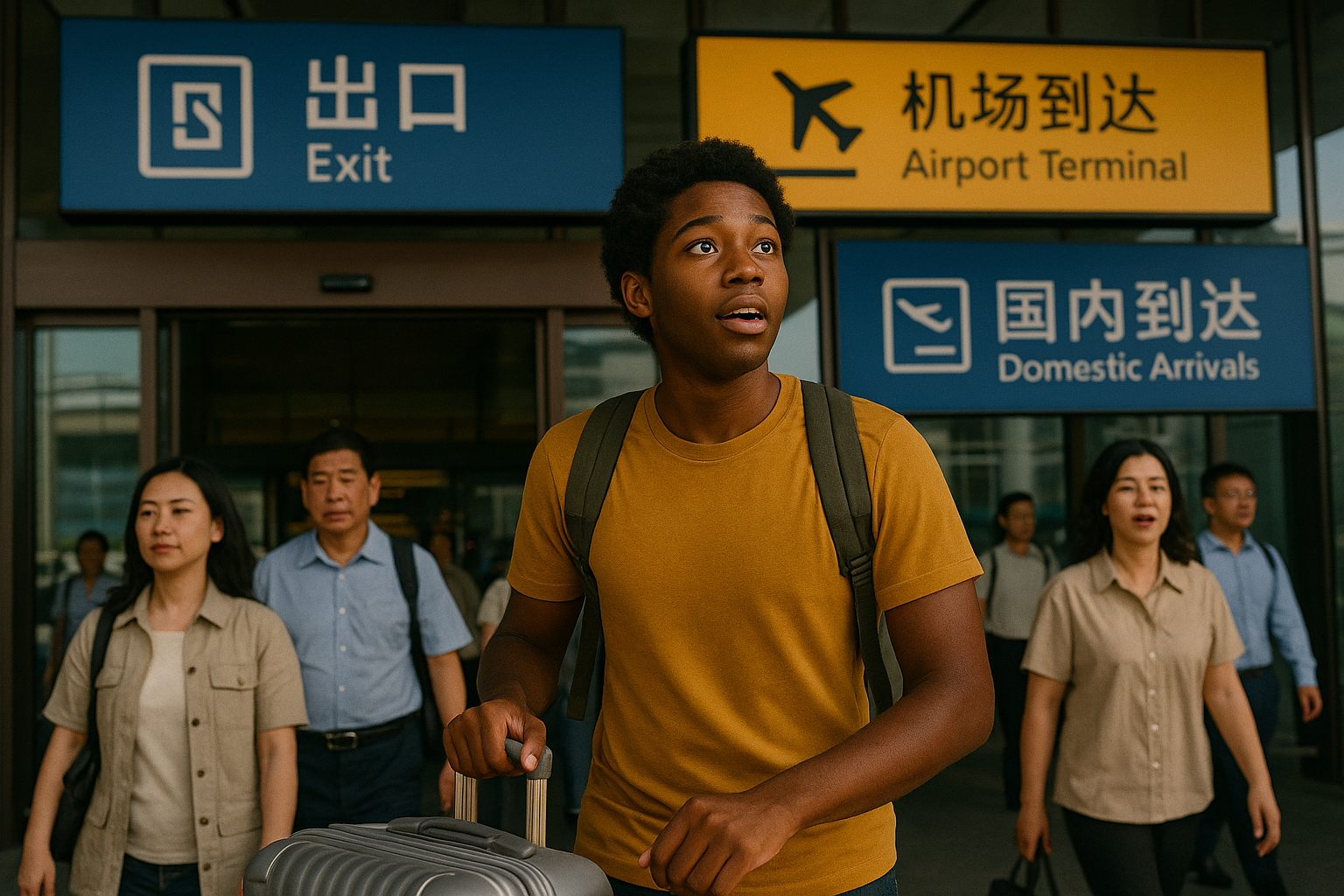
🧳 Introduction: You’ve Landed—Now What?
So, you’ve done it. After months—maybe years—of Mandarin classes, watching Chinese dramas with subtitles, drilling tones, and nervously practicing “Nǐ hǎo” to your dog, you’ve finally arrived in China. The signs are in Chinese, the smells are unfamiliar, and there’s a wall of language and culture all around you.
The question hits you like a blast of humid air at the airport: Am I ready for this?
Whether you’re in China for a semester abroad, an internship, a teaching job, or a solo language-learning adventure, your first week will be a rollercoaster. The highs can be euphoric—your first conversation in Mandarin with a local, your first street food victory, your first successful subway ride. The lows? Confusion, jet lag, culture shock, and moments of self-doubt that make you question whether all that studying was enough.
But here’s the truth: your first week in China is not just a test of your Mandarin—it’s the beginning of a mindset shift. A week when your textbook grammar meets real-world accents, when your listening skills are challenged by background noise and slang, and when you begin to realize that this is where the learning really begins.
In this article, we’ll walk you through exactly what to expect in your first week in China as a Mandarin learner. From the airport to your first market interaction, from mental hurdles to linguistic wins, we’ll cover it all—so you can step into this next chapter with confidence, curiosity, and a whole lot of flexibility.
✈️ Day 1: Arrival, Culture Shock, and Your First Language Challenge
🛬 The Airport Experience
You might think your Mandarin will come into play right away—but surprisingly, you’ll glide through customs and baggage claim with minimal speaking. Still, this is your first exposure to spoken Chinese in the wild. Announcements are fast and often mumbled. Take note of rhythm and cadence. You're building your listening muscle already.
🤯 Culture Shock Is Real
The noise, the smells, the pace, the crowds—China is intense. Expect to feel overwhelmed. It doesn’t mean you’re not ready. It means your brain is recalibrating.
🗣 Your First Mandarin Encounter
It might be with a taxi driver, airport staff, or the person at your hotel’s front desk. You’ll speak slowly, nervously. Maybe they’ll respond in English. Maybe not. Either way—it counts. You’re now a real-world language learner.
🧭 Days 2–3: Orientation, Logistics, and Early Wins
🏨 Checking In
At smaller hotels or hostels, don’t expect fluent English. Use key phrases:
我要入住。Wǒ yào rùzhù. (“I want to check in.”)
我有预订。Wǒ yǒu yùdìng. (“I have a reservation.”)
Carry printed versions of your booking in Chinese. Watch how the staff reply—you’ll pick up essential vocabulary like 身份证 (ID), 密码 (password), and 楼 (floor).
🗺 Getting Around
Start with something simple: the subway. Chinese subway systems are clean, efficient, and mostly bilingual. Still, listening to real station announcements is a whole new ballgame. Try shadowing the names under your breath. You’ll improve pronunciation and tone awareness without even realizing it.
💡 First Tip: Record Yourself
Each night, record a voice memo in Mandarin—even if it’s just “Today I went to the park.” This builds fluency and reveals your improvement over time.
🍜 Day 4: Food, Menus, and Ordering Like a Local
🥢 Ordering Without Panic
Your Mandarin gets a workout at meal times. Street vendors, noodle shops, and small restaurants may have no English menu. This is your moment. Look for:
指着点菜 (point and order)
Sample phrases:
我要这个。Wǒ yào zhège. (“I want this.”)
少辣,谢谢。Shǎo là, xièxie. (“Less spicy, please.”)
📱 Use Your Tools
Apps like Pleco, Google Translate (with offline language pack), and Baidu Translate are your friends. But don’t over-rely. Even if you make mistakes, use your Mandarin. Locals usually appreciate the effort.
🧑🏫 Days 5–6: Language School or On-the-Street Learning?
🏫 Enrolling in Classes
If you’re attending a language school, your first few days will include placement tests, schedule orientation, and your first classes. Expect to be humbled—but in a good way.
Chinese classrooms often emphasize listening and repetition over grammar charts. It may feel different from what you’re used to—but it works.
👂 Street-Level Mandarin
Language learners quickly realize that “textbook Mandarin” sounds very different from what you hear in real life. People speak fast. They use local slang. They drop tones.
Don’t get discouraged. This is where the magic happens. You’ll begin to recognize common sentence patterns and filler words (like 就是 or 那个) that textbooks often skip.
🧠 Day 7: Emotional Rollercoasters and the Language Plateau
😵💫 The “What Did I Just Learn?” Feeling
Around Day 7, many learners hit a temporary slump. You’ve been absorbing a new culture and language nonstop. You may feel like you’re making no progress.
But here’s the truth: this is a natural part of the immersion curve. Your brain is sorting and processing. The breakthrough is around the corner.
🎯 Reflection & Realization
Look at what you’ve already done:
Navigated airports and metro stations
Ordered food in Mandarin
Understood (some) native speech
Learned how to adapt
You’re not just surviving. You’re growing.
🔄 What Changes After Week One?
Week two will feel less foreign. Street names will sound more familiar. You’ll start to recognize patterns in signs and speech. You’ll feel more comfortable making mistakes.
By now, you’ve crossed an invisible threshold: you’re no longer studying Chinese, you’re living it.
📘 FAQs: Your First Week in China as a Mandarin Learner
Q: What if I completely freeze in my first Mandarin interaction?
A: It happens! Take a breath, smile, and use the words you know. Locals are usually patient if they see you’re trying.
Q: Is it better to speak broken Mandarin or rely on translation apps?
A: Always try Mandarin first—even if it’s simple. Use apps as a backup.
Q: Will locals correct my Mandarin?
A: Some will—usually kindly. Others may just nod and move on. Either way, you’ll learn through trial and error.
Q: What are some useful beginner phrases for week one?
你可以帮我吗?(Can you help me?)
厕所在哪里?(Where’s the bathroom?)
我听不懂。(I don’t understand.)
没关系。(It’s okay.)
谢谢!(Thank you!)
Q: How do I deal with regional accents?
A: Start with big cities like Beijing or Shanghai where standard Mandarin is more common. With time, your ear will adapt.
Q: What if I get homesick or overwhelmed?
A: Totally normal. Call a friend, take a break from language learning, or find an expat café. This is part of the process.
🎓 Final Thoughts from Polyglottist Language Academy
Your first week in China will not go as planned—and that’s a good thing. It’s in those off-script moments that language learning becomes real. You’ll learn more from a confused conversation with a taxi driver than from ten grammar exercises. You’ll grow from awkward silences, hand gestures, and moments of pure surprise.
At Polyglottist Language Academy, we prepare students not just to speak Mandarin—but to live it. Our courses focus on practical, real-life situations you’ll encounter from the moment you land in China.
If you're considering a trip, internship, or long-term stay, why not prepare with us first? Learn how to navigate street signs, decode menus, and build real conversational confidence.
👉 Join our Mandarin classes today—in-person or online—and get ready for your first week in China the smart way.
📚 Don’t Miss These Related Articles
What To Expect In Your First Adult Mandarin Class (And Why You’ll Love It)
How Mandarin Can Boost Your Career In The Bay Area Tech And Business Scene
Why Learning Mandarin As An Adult Is More Doable Than You Think
From Dumplings To Dialogues: How To Speak Mandarin At Bay Area Restaurants
Best Mandarin Classes For Busy Professionals In The Bay Area