
8 Unspoken Rules of Chinese Hospitality
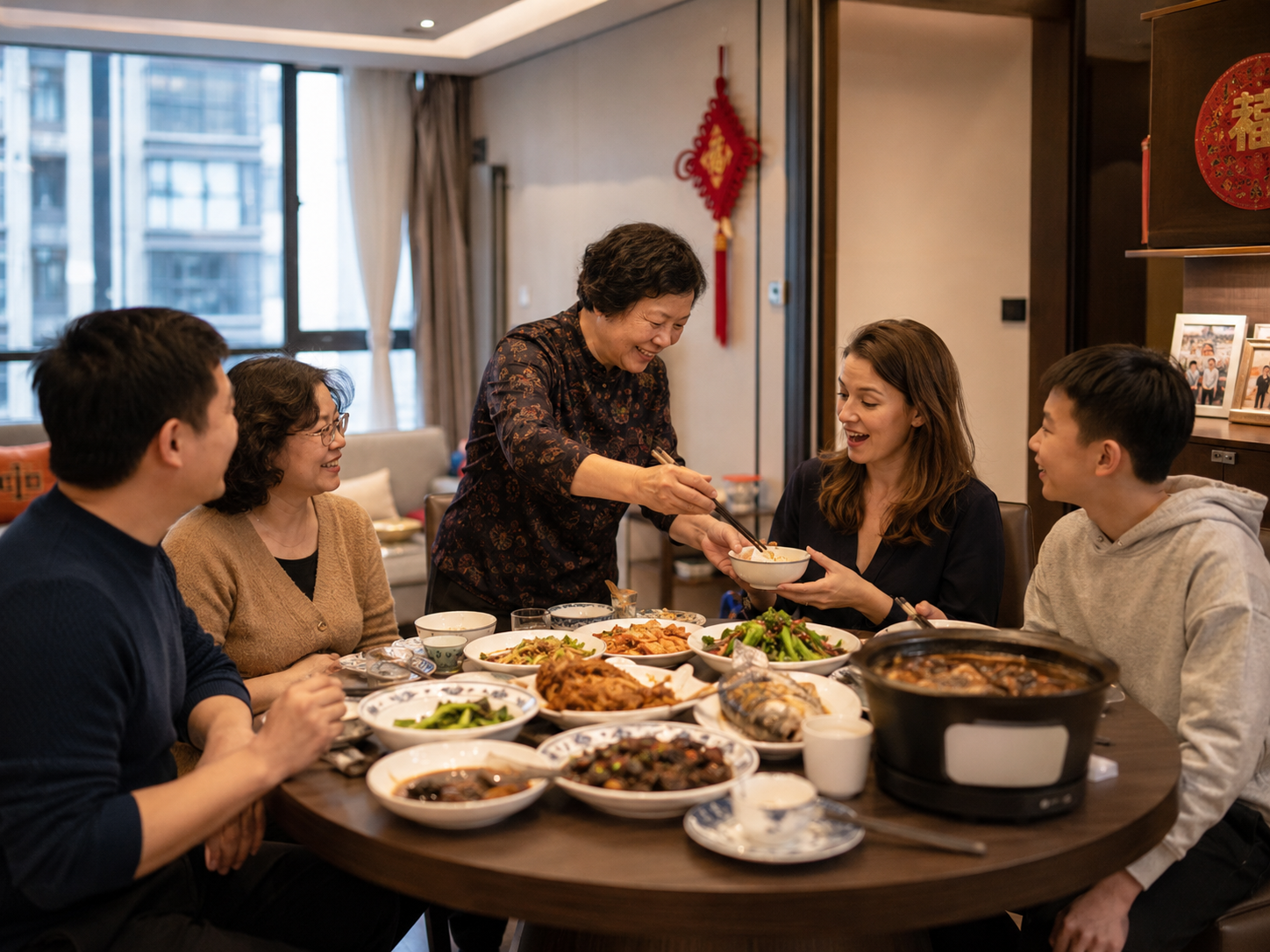
A foreign guest sits down for dinner with a Chinese family and quickly notices that the table looks as though twice as many people were expected. There are cold dishes, vegetables, fish, meat, soup, perhaps dumplings or noodles, and more food still arriving from the kitchen.
The guest eats, compliments the meal, and eventually says they are full.
“Have some more,” the host says.
A few minutes later, another piece of food appears in the guest’s bowl.
Then, at the end of the evening, the host apologizes that the meal was nothing special.
For someone unfamiliar with Chinese hospitality, the whole exchange can be slightly confusing. Why prepare so much food? Why keep offering it after the guest has said no? Why describe an elaborate dinner as simple? And if the meal happens in a restaurant, why can paying the bill turn into a negotiation of its own?
These customs make more sense once hospitality is understood not simply as friendliness, but as a role. In many Chinese social settings, once someone becomes the host, they also take on a certain responsibility for making sure the guest is comfortable, well fed, properly welcomed, and looked after.
How strongly that role is expressed varies enormously. Dinner with university friends may be completely casual, while meeting someone’s parents or attending a formal business banquet can feel very different. But there are several patterns visitors encounter often enough to be worth understanding.
1. A Full Table Is Part of the Welcome
One of the first things visitors notice at a Chinese meal is abundance.
At a restaurant, especially when one person is clearly hosting, ordering only enough food to satisfy everyone’s hunger can feel different from ordering enough to make the table look generous. The meal itself becomes part of the welcome.
A host may choose several dishes so that guests have a variety of things to try. There might be meat, vegetables, fish, soup, and something considered a local specialty. If the occasion is important, one or two dishes may be more elaborate than anything the host would order for an ordinary weekday meal.
The amount of food does not necessarily correspond to how much anyone is expected to eat. Sometimes the abundance is part of the message: there is plenty, the guest has choices, and the host has prepared properly.
This is also why older advice about Chinese dining sometimes claims that guests should deliberately leave food uneaten to prove they were served enough. That is far too rigid for contemporary China. Attitudes toward food waste have changed, and many families and younger diners would much rather avoid unnecessary leftovers.
At a casual meal among friends, nobody may think about any of this. At a family gathering, formal dinner, or business meal, however, a sparse-looking table can still feel a little underprepared.
So if you arrive at dinner and wonder how eight people could possibly eat everything in front of them, remember that the host may be thinking less about portion control than about making sure nobody feels insufficiently welcomed.
2. “Eat More” Often Means “I’m Taking Care of You”
One of the phrases Mandarin learners are likely to hear around a dinner table is:
多吃一点。
Duō chī yìdiǎn.
“Eat a little more.”
Or:
再吃一点吧。
Zài chī yìdiǎn ba.
“Have a little more.”
To an English speaker, these phrases can sound oddly literal. If the guest has already eaten a full meal, why is the host still paying attention to their plate?
Because in many families, encouraging someone to eat is one of the ways care is expressed.
Parents and grandparents may be especially enthusiastic about this. A host may point out a particular dish, rotate the lazy Susan toward the guest, or place a piece of food directly into their bowl. From the host’s point of view, this is often attentiveness rather than pressure.
Of course, the guest does not need to keep eating until they are uncomfortable.
A useful phrase is:
我吃饱了,谢谢。
Wǒ chī bǎo le, xièxie.
“I’m full, thank you.”
If the encouragement continues and you really cannot manage another bite:
真的吃不下了。
Zhēnde chī bu xià le.
“I really can’t eat any more.”
A warm refusal combined with appreciation for the meal usually communicates exactly what you need.
Among younger friends, the whole exchange may be much more relaxed. Someone may ask once whether you want more and accept your answer immediately. The repeated encouragement is more noticeable in families, especially with older relatives, which is one reason a young Chinese friend can seem completely casual at lunch and much more attentive when you visit their parents.
3. The Best Food May Keep Finding Its Way Toward You
At a shared Chinese meal, visitors sometimes notice that certain dishes seem to migrate toward them.
A host might rotate the lazy Susan so that a particular dish stops directly in front of the guest, point out the best part of a fish, or urge them to try something expensive, seasonal, or difficult to prepare.
In a more traditional family setting, an older person may simply put the food into the guest’s bowl.
Offering someone something particularly good can be a small but visible way of showing respect. If the host ordered a dish because they wanted you to experience it, your willingness to taste it may matter more than you realize.
This can create an amusing mismatch. A foreign guest, trying hard not to impose, repeatedly chooses the simplest vegetables on the table. The host, meanwhile, keeps directing them toward the dish they ordered especially for the guest.
There is no need to study the table and work out which piece of fish has the highest social value. In plenty of meals, none of this matters.
But if a host keeps saying, “Try this one,” there is usually a reason.
4. At a Formal Meal, Let the Host Show You Where to Sit
At an ordinary lunch with friends, seating may be completely casual. People arrive, choose chairs, put down their phones, and begin talking.
A more formal dinner can be different.
Traditional banquet seating may reflect age, seniority, professional position, or who is being honored. The most important seat can depend on the room and its relation to the entrance, and a host may already have a particular place in mind for a guest.
Foreign visitors sometimes encounter elaborate diagrams explaining exactly where everyone should sit at a Chinese banquet. Unless formal entertaining is part of your job, you probably do not need to memorize them.
If the meal feels formal, just give the host a moment to indicate your seat.
That solves most of the problem naturally. It also allows the host to arrange the table as they intended. If someone is clearly directing people toward particular chairs, repeatedly insisting that you are happy to sit anywhere can actually make the process more awkward.
Among friends, the same rule may be irrelevant. At a casual hot-pot dinner after work, nobody is likely to care which chair you chose.
In practice, the relationship usually tells you more than a diagram of banquet seating ever will.
5. One Offer May Not Be the Final Offer
Hospitality also has its own rhythm of offering and refusing.
In many English-speaking settings, this exchange is enough:
“Would you like some tea?”
“No, thanks.”
The subject is closed.
In some Chinese settings, the tea may be offered again. Fruit appears a little later. Someone asks whether you are sure you do not want another piece. The repetition can feel unnecessary if you assume the first offer was merely a request for information.
Sometimes, though, offering again shows that the offer was sincere.
The guest may also refuse initially because they do not want to inconvenience the host or appear too eager. The host knows that possibility and offers once more.
There is no rule that people must refuse a certain number of times before accepting. That kind of advice turns a flexible social habit into a ritual it usually is not. Among close friends, an offer and answer may be perfectly direct.
One Mandarin expression captures the underlying idea particularly well:
别客气。
Bié kèqi.
It is often translated as “you’re welcome,” but in hospitality it can mean something closer to “Don’t stand on ceremony” or “Make yourself comfortable.”
The word 客气 (kèqi) is interesting because 客 means “guest.” To be too 客气 can mean remaining overly formal or behaving as though you are still an outsider who must be careful not to impose.
So when a host says:
别客气,多吃一点。
Bié kèqi, duō chī yìdiǎn.
the meaning is not simply “Don’t be polite. Eat more.”
It is closer to: “Relax, you’re our guest. Have some more.”
That is a good example of why Mandarin sometimes makes much more sense when you understand the situation around the words rather than only their dictionary definitions.
6. The Bill May Already Belong to the Host
At the end of a restaurant meal, the foreign guest reaches for their wallet.
“Let’s split it.”
The host refuses.
The guest insists.
The host refuses again, this time with enough determination to make it clear that this is not going to be a quick calculation.
For many visitors, this is one of the most memorable parts of Chinese hospitality.
The important question is often not simply who ate what, but who invited whom.
A person taking friends out to celebrate something may expect to pay. A senior relative may pay for younger family members. Someone entertaining a business guest may see covering the meal as part of the invitation itself.
There can also be an element of 面子 (miànzi), or “face.” Hosting well is visible, and generosity can carry social meaning. A host who has invited guests may feel that paying is part of doing the job properly.
At the same time, casual splitting is extremely common in contemporary China, especially among younger friends. WeChat Pay and Alipay make transferring money almost effortless, and friends may divide a bill immediately or take turns paying on different occasions.
The setting tells you a lot. A spontaneous lunch with colleagues is not the same as dinner someone explicitly invited you to.
If the other person clearly sees themselves as the host, you can offer to contribute without feeling that you must win the argument. Sometimes the easiest response is simply, “Then next time, dinner is on me.”
That recognizes the hospitality while leaving room for reciprocity.
For readers interested in the broader social idea behind these exchanges, the related concept of 面子 helps explain why paying, generosity, and public roles can sometimes carry meanings beyond the money itself.
7. The Host May Downplay Everything They Just Did
You arrive to find an impressive table covered with food.
The host has clearly spent hours preparing it.
You compliment the meal.
“Oh, it’s nothing,” they say.
Or: “We didn’t make very much.”
Taken literally, this can be confusing.
Modesty often forms part of the exchange around hospitality. The host may downplay their effort rather than enthusiastically agreeing that the meal is impressive.
Mandarin has several expressions associated with modest responses to praise. A traditional example is:
哪里哪里。
Nǎli nǎli.
Literally, “where, where,” it has traditionally been used to reject or soften a compliment, something closer to “Not at all.”
Another response you may hear is:
没有没有。
Méiyǒu, méiyǒu.
“No, no, not really.”
Actual speech varies considerably. Younger speakers may simply say 谢谢 (xièxie) — “thank you” — especially in informal situations. There is no requirement to reject every compliment.
The useful thing to recognize is that a host minimizing their effort does not mean your praise was misplaced. They may be following a familiar style of modest response.
If the food was excellent, tell them. They will understand.
8. Hospitality May Continue After You Leave the Table
The meal ends, everyone stands up, and a visitor assumes the evening is over.
Then the host walks them downstairs.
Outside, someone helps call a taxi. They wait until it arrives. Later, a message appears: “Did you get home?”
If the visit took place at someone’s home, the guest may also discover that they are leaving with fruit, snacks, leftovers, or some other food they never asked for.
For a visitor used to a quick goodbye at the front door, this can seem like an extraordinary amount of attention. From the host’s perspective, it may simply be the final part of hosting.
Seeing a guest off is an important gesture in many families. How far it goes depends on the people involved. Close friends may wave goodbye at the elevator. Older relatives may accompany you much farther than you think necessary. Someone hosting an important visitor may remain attentive until transportation is settled.
Sending food home with a guest follows a similar logic. The meal may be over, but the impulse to take care of the person has not disappeared quite yet.
Hospitality Changes With the Relationship
One reason rigid etiquette lists are so misleading is that the same person may behave very differently in different settings.
Imagine a young Chinese professional meeting a friend for lunch. They order a few dishes, split the bill through WeChat, sit wherever they like, and accept “No thanks, I’m full” without another word.
A week later, that same person brings the friend home to meet their parents.
Tea appears immediately. Then fruit. Dinner contains twice as many dishes as expected. Someone’s mother keeps asking whether the guest has eaten enough, while someone’s father begins arranging transportation home before anyone has even stood up from the table.
Nothing contradictory is happening. The social setting has changed.
Family hospitality, especially involving parents or older relatives, may preserve habits that barely appear among younger friends. Business meals can have another set of expectations again.
That is why broad claims such as “Chinese people always fight over the bill” or “you must refuse three times” are not very helpful. The relationship usually matters more than the supposed rule.
Visiting Someone’s Home Makes the Host-Guest Relationship Especially Visible
Restaurants receive a lot of attention in discussions of Chinese etiquette, but home visits can make these patterns even easier to see.
A guest may be offered tea or water almost immediately after arriving. Fruit might appear even if the visit falls nowhere near a meal. Snacks are opened simply because there is someone visiting.
This is one place where excessive politeness can occasionally work against itself.
The guest thinks, “I don’t want to impose, so I’ll refuse everything.”
The host thinks, “My guest hasn’t eaten or drunk anything. I need to offer something else.”
And so the cycle continues.
Sometimes accepting a cup of tea, a piece of fruit, or a small snack actually makes everyone more comfortable.
You can still decline things you genuinely do not want. But allowing someone to host you is sometimes part of being a considerate guest.
What Foreign Guests Actually Need to Do
Chinese hospitality is easier to navigate once you stop treating it as an etiquette exam.
You do not need to know the formal seating order at every banquet, eat everything placed in front of you, or engage in a dramatic struggle over every restaurant bill.
Pay attention instead to the role the other person seems to be taking.
If someone is clearly excited for you to try a particular dish, try it if you can. If a host keeps offering food after you are full, thank them and decline warmly. At a formal dinner, wait to see whether someone directs you toward a seat. If a person who invited you to dinner is determined to pay, you can accept and return the hospitality another time.
And when someone says 别客气, listen to more than the literal words. They may be telling you that there is no need to remain quite so carefully in the role of guest.
These small interactions are also useful for Mandarin learners because they show how language operates inside relationships. A phrase can be grammatically simple and still carry social information that disappears in translation. In class, practicing those situations can be just as valuable as memorizing another vocabulary list.
Polyglottist Language Academy offers Mandarin instruction for learners who want to work on both the language itself and the way it is used in everyday situations.
Think again about the dinner at the beginning. The overflowing table, the repeated encouragement to eat, the host’s modest comments, and the disagreement over who pays may initially look like four unrelated cultural habits.
From the host’s perspective, they can all be parts of the same responsibility: making sure the guest leaves feeling that they were properly cared for.
A foreign guest does not need to reproduce every custom perfectly. Recognizing that intention, accepting some of the hospitality, and showing genuine appreciation is usually enough.