
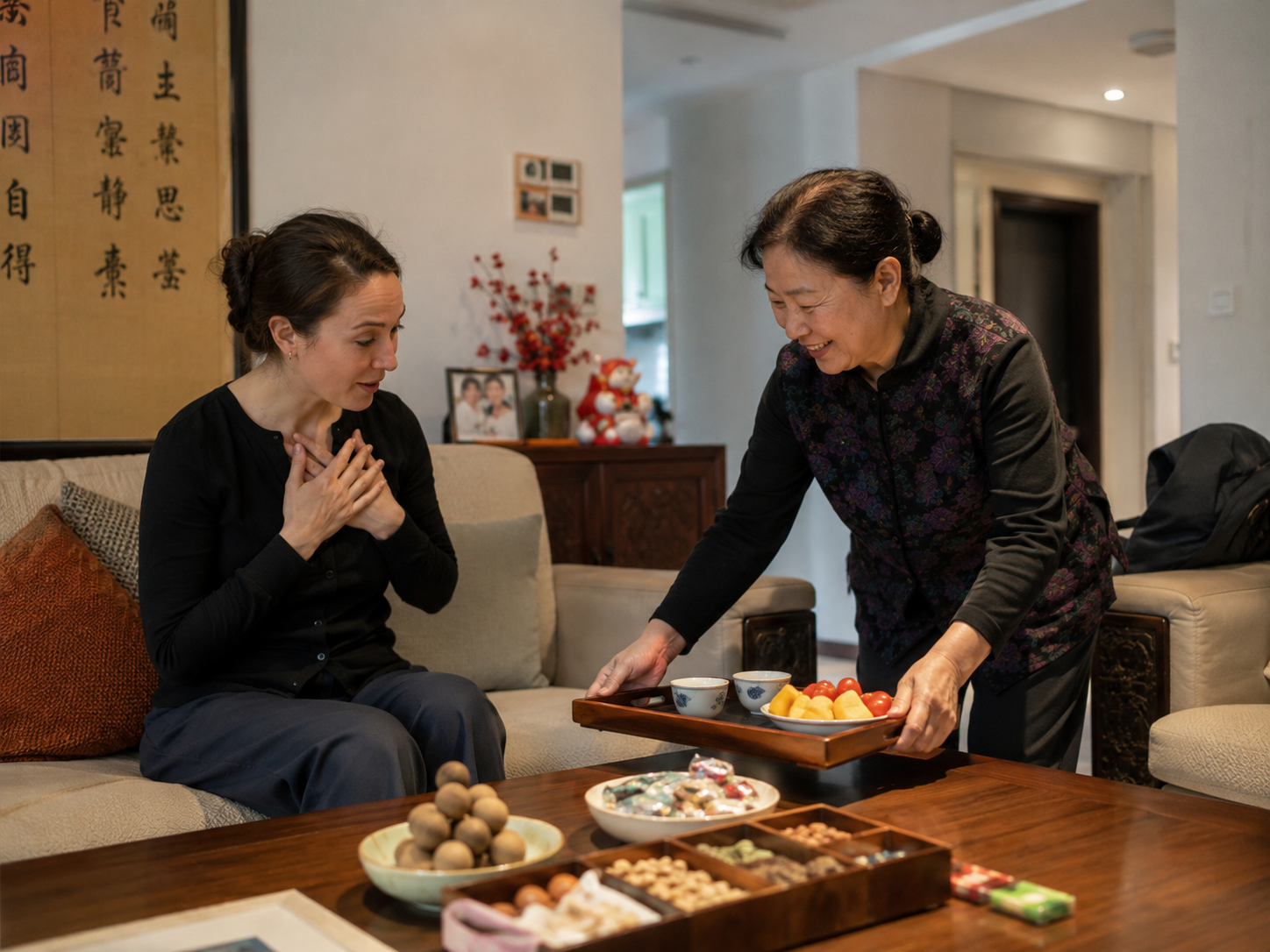
You arrive at a Chinese friend’s parents’ home carrying a small gift. Within a few minutes, tea appears. Then fruit. Someone asks whether you have eaten yet, even though dinner is clearly being prepared. When the meal begins, the table is covered with more dishes than you expected, and an older relative keeps encouraging you to try one more thing.
You say you are full.
A few minutes later, someone offers you another piece of fish.
For a first-time visitor, it can be difficult to tell what is expected. Should you keep accepting food? Should you take your shoes off? Were you supposed to bring something more impressive? Are you staying too long? Are you supposed to help clear the table?
In most cases, the answer is much less complicated than a traditional etiquette guide makes it sound. Visiting a Chinese family is rarely a test of whether you know a secret set of rules. What matters far more is recognizing that the family may take the role of host seriously. Their attention to food, comfort, seating, and even your trip home is usually intended to make you feel properly welcomed.
Families vary enormously, of course. Visiting a young friend’s apartment in Shanghai may feel completely different from having dinner with their parents and grandparents. A household accustomed to international guests may be very relaxed, while another family may follow more traditional habits.
Still, a few patterns are common enough that understanding them can make a first visit much easier.
Before You Arrive, Confirm the Time
There is no need to turn punctuality into a cultural puzzle. If someone invites you for dinner at a particular time, aim to arrive around then and send a message if you are delayed.
What is more useful to know is that arriving very early can be inconvenient. If the family is cooking, cleaning, or arranging the table, appearing half an hour before expected may catch them in the middle of preparations.
A family dinner may also begin earlier than some visitors are used to, especially if older relatives are involved. Rather than assuming dinner means the same hour it would at home, simply confirm the plan.
If your friend says, “Come around six,” there is no need to arrive at 5:30 to prove your enthusiasm.
Bring Something Small Rather Than Something Impressive
For a casual visit with a close friend, a gift may not be necessary at all. But if you are meeting someone’s parents for the first time, being invited for a holiday, or attending a more formal family dinner, bringing something small is usually a thoughtful gesture.
Fruit is a classic choice because it can be shared. Tea, pastries, chocolates, or a specialty from your own country or region can also work well.
The goal is not to demonstrate how much money you spent.
An expensive gift can sometimes create more discomfort than pleasure, particularly if the family feels they now need to reciprocate. Something simple that everyone can enjoy is often better.
You may come across long lists online warning foreigners never to give clocks, umbrellas, pears, certain colors of wrapping paper, or particular numbers of objects. Some of these associations have real linguistic or cultural backgrounds. For example, 送钟 (sòng zhōng), “to give a clock,” sounds like 送终 (sòng zhōng), referring to attending to someone at the end of life or seeing them through death.
That does not mean a young Chinese family will panic if a foreign visitor unknowingly brings the “wrong” object. These associations matter more to some people than others.
For a first visit, you can avoid most of the uncertainty by choosing something ordinary and shareable.
At the Door: Should You Take Your Shoes Off?
This is one of the questions visitors worry about most, and fortunately the solution is simple.
Look at what everyone else is doing.
Some Chinese households expect outdoor shoes to come off at the entrance and may keep slippers ready for guests. Others are completely relaxed about shoes. There is no reliable rule that applies to every home.
If slippers are offered, use them. If everyone is clearly removing their shoes, follow along.
If you are unsure, ask:
要脱鞋吗?
Yào tuō xié ma?
“Should I take my shoes off?”
Nobody is going to think this is an embarrassing question. Asking is much more natural than standing in the doorway trying to work out the household policy from where everyone’s shoes happen to be.
Let Your Friend Handle the Introductions
Meeting parents or grandparents can feel more formal than meeting peers, especially if this is the first time.
Let the person who invited you introduce everyone. They will also usually make it clear what you should call the family members.
Mandarin sometimes uses family terms for people who are not literal relatives. 阿姨 (āyí), for example, literally means “aunt,” while 叔叔 (shūshu) means “uncle,” but these words can also be used respectfully for adults of an older generation.
That does not mean you should automatically walk into someone’s home and assign everyone a family title.
If your friend introduces their mother as “阿姨” and encourages you to call her that, use it. If the family prefers names or another form of address, follow their lead.
A simple greeting is enough. You do not need to produce an elaborate formal speech in Mandarin to make a good first impression.
Do Not Be Surprised When Food Appears Before the Meal
You sit down.
Tea arrives.
Then a plate of fruit.
Then perhaps nuts, sunflower seeds, sweets, or packaged snacks.
Dinner may begin in twenty minutes.
This is completely normal in many homes.
Offering something shortly after a guest arrives is one of the most visible forms of hospitality. The host does not necessarily think you are desperately hungry. Putting tea, water, fruit, or snacks in front of you is simply part of receiving you properly.
This can create a small cultural misunderstanding when the guest tries very hard not to impose.
The visitor thinks, “They have already gone to so much trouble. I should refuse everything.”
The host thinks, “My guest hasn’t accepted anything. Maybe I should offer something else.”
Now another type of tea appears.
Sometimes the easiest thing to do is accept a little.
A cup of tea or a piece of fruit is enough to let the host feel that the hospitality has been received without requiring you to eat continuously from the moment you arrive.
This is also where one of the most useful Mandarin expressions comes in:
别客气。
Bié kèqi.
It is often taught as “you’re welcome,” but in a home it can mean something closer to “Don’t stand on ceremony” or “Make yourself comfortable.”
The word 客气 (kèqi) is particularly revealing because 客 (kè) means “guest.” Being too 客气 can suggest maintaining too much polite distance, behaving as though you must be extremely careful not to trouble anyone.
When someone tells you 别客气, they are often encouraging you to relax a little.
Personal Questions May Come Earlier Than You Expect
Conversation with older relatives can sometimes surprise foreign visitors more than the food does.
Someone may ask how old you are, where you work, whether you are married, whether you have children, how long you plan to stay in China, or even how much something costs.
Depending on where you come from, some of those questions may feel unusually personal for a first meeting.
They are not necessarily intended as an interrogation.
For many older people, these questions help place someone socially and create conversation. Age, work, education, marriage, and family are common reference points. Asking about them can be a way of showing interest rather than deliberately crossing a boundary.
That does not mean you have to answer everything.
If a question feels too personal, you can keep the response vague, smile, and redirect the conversation. Most people are perfectly capable of recognizing that a foreign guest may have different boundaries.
Younger relatives may avoid these questions entirely, while grandparents may ask several within the first ten minutes. Family habits matter as much as nationality here.
Dinner Is Usually About Shared Food
When the meal begins, expect the center of the table to matter more than your individual plate.
Chinese family meals commonly involve several shared dishes rather than each person ordering or receiving a completely separate entrée. Depending on the setting, there may be a lazy Susan, and dishes will circulate around the table.
A host may point toward something and say:
尝尝这个。
Chángchang zhège.
“Try this.”
You may also hear:
多吃一点。
Duō chī yìdiǎn.
“Eat a little more.”
Sometimes an older family member will place food directly into your bowl.
For visitors accustomed to serving themselves, this can feel surprisingly intimate. Usually it is meant as attention rather than control. The person may be giving you a particularly good piece or making sure you try a dish they are proud of.
If you can eat it, tasting something the host specifically recommends is a nice gesture.
You do not need to try absolutely everything.
If you have allergies, dietary restrictions, or foods you cannot eat, it is much easier if your friend tells the family beforehand. That saves everyone from discovering the problem after a special dish has already been placed in your bowl.
Yes, You Are Allowed to Be Full
Repeated encouragement to eat is probably the part of Chinese family hospitality most likely to make foreigners nervous.
You say you are full.
Someone tells you to have a little more.
You say you are really full.
Someone points out that you have not tried the dumplings yet.
The important thing to understand is that “eat more” can function as an expression of care. It does not necessarily mean the host expects you to obey every time.
When you have had enough, say so warmly:
我吃饱了,谢谢。
Wǒ chī bǎo le, xièxie.
“I’m full, thank you.”
If necessary:
真的吃不下了。
Zhēnde chī bu xià le.
“I really can’t eat any more.”
You can combine the refusal with a compliment:
很好吃,但是我真的吃饱了。
Hěn hǎochī, dànshì wǒ zhēnde chī bǎo le.
“It’s delicious, but I’m really full.”
That is often easier than repeatedly accepting food because you are afraid refusal itself is offensive. Declining more food is perfectly fine; it helps if the host can also hear that you enjoyed what you already ate.
Compliment the Food, Even If the Host Disagrees With You
If someone has cooked for you, saying that the food is good is one of the easiest ways to show appreciation.
很好吃。
Hěn hǎochī.
“It’s delicious.”
The response may not be what you expect.
After preparing an enormous meal, the host might say that it was simple, that they did not make much, or that they are not a particularly good cook.
You may hear:
没有没有。
Méiyǒu, méiyǒu.
“No, no, not really.”
A more traditional expression is:
哪里哪里。
Nǎli nǎli.
Literally “where, where,” it has historically been used to downplay praise.
Younger people may simply say 谢谢 (xièxie) and move on. Responses to compliments are changing, and there is no need to expect ritual modesty from everyone.
If the host minimizes the meal, you do not need to retract your compliment. Smile, keep eating, and let the compliment stand.
Should You Help With the Dishes?
Offering is polite.
Actually being allowed to help is another matter.
If you are visiting someone’s parents for the first time, you may stand up after dinner and offer to carry dishes into the kitchen. The hosts may immediately tell you to sit down.
Do not take that personally. They may consider cleaning up part of their responsibility as hosts.
You can offer once:
“Can I help?”
If they clearly say no, you do not need to sneak into the kitchen and begin washing bowls to prove that you are useful.
In a close friend’s home, things may be completely different. Everyone might clear the table together.
Again, watching the household is more useful than trying to follow an absolute rule.
If They Take You to a Restaurant, the Bill Can Be a Separate Social Event
Sometimes a family visit moves to a restaurant rather than taking place at home.
At the end of the meal, you may offer to contribute.
The host may refuse.
If they invited you, particularly if you are their child’s guest or meeting the family for the first time, they may feel quite strongly that paying is part of hosting.
This overlaps with the broader Chinese idea of 面子 (miànzi), or “face.” Generosity and the ability to host someone well can carry social meaning, especially when other people are present.
That does not mean every restaurant dinner becomes a battle over the bill. Younger friends routinely split costs, transfer money through WeChat or Alipay, or take turns paying.
With parents or older relatives, however, accepting the invitation can sometimes be more graceful than repeatedly insisting on dividing the cost.
You can always say that next time you would like to treat them.
That allows hospitality to become reciprocal without turning the restaurant entrance into a wrestling match.
Staying for a While After Dinner Is Usually Fine
If dinner finishes and fruit appears again, do not assume the family is trying to feed you for a second time.
After-meal fruit, tea, conversation, or television may simply be part of the visit.
Leaving immediately after the final bite can sometimes make the evening feel more transactional than intended, as though you came only to eat.
You do not need to remain for hours either.
There is no universal correct length for a home visit. Pay attention to the rhythm of the evening. Conversation may begin to slow. Other guests may leave. Someone may ask how you are getting home. Your friend may start discussing transportation.
If you already know you need to leave at a particular time, mentioning it earlier is often easier than suddenly looking at the clock and announcing that you must disappear immediately.
The Goodbye May Have Several Stages
You say goodbye in the living room.
Everyone walks to the door.
You put on your shoes.
Someone walks you to the elevator.
Then they come downstairs.
Then they stand outside while your taxi arrives.
For a visitor, it can feel as though the farewell keeps restarting.
Seeing guests off is part of hospitality in many families. The degree varies, but accompanying someone beyond the front door can be a way of completing the visit properly.
You may also find yourself carrying something you did not arrive with.
Fruit. Leftovers. Snacks. Something the family bought for you.
If the host insists that you take a little food home, accepting it is often easier than conducting another round of polite refusal in the doorway.
A useful phrase as you leave is:
谢谢你们招待我。
Xièxie nǐmen zhāodài wǒ.
“Thank you for having me.”
The family may later send a message asking whether you arrived home safely. Answering is part of closing the loop.
The Family Setting Can Change Everything
Your Chinese friend may split a restaurant bill with you down to the last yuan, order takeout at home, and barely notice whether you have eaten enough.
Then you visit their parents.
Slippers appear at the door. Tea is waiting before you sit down. Their mother asks whether you are hungry. Their father insists on paying for dinner. Someone sends you home with enough fruit for several days.
There is no contradiction in this. Different generations and different host-guest relationships bring out different habits.
That is why broad rules about “Chinese family etiquette” only go so far. The best clues usually come from the people you are actually visiting.
Being Too Polite Can Sometimes Make Things Harder
Foreign guests often make the same well-intentioned mistake: they refuse everything.
No tea, thank you.
No fruit.
No snacks.
No need to give me the good seat.
Please do not make extra food.
I’ll pay for dinner.
Don’t walk me downstairs.
The guest is trying not to impose. The host, meanwhile, is trying to take care of the guest, and all the refusals can leave them looking for some other way to do it.
You do not have to accept every offer. But accepting some hospitality often makes the visit easier.
Drink some tea. Try the dish they are proud of. Let the parents pay if they clearly invited you and insist. Accept the fruit if declining it has already become a ten-minute conversation.
Then thank them sincerely.
For Mandarin learners, visits like these are also a reminder that ordinary phrases often carry more social meaning than their dictionary translations suggest. 别客气, 多吃一点, and 我吃饱了 all become easier to understand once you hear them in the situations where people actually use them.
This is one reason structured Mandarin study can be useful: learners have a chance to practice not only what a phrase means, but when it sounds natural and what it communicates in a particular relationship. Polyglottist Language Academy offers Mandarin classes for learners who want to develop that kind of practical understanding.
By the time the visitor from the beginning finally leaves, the evening may have included tea, fruit, more food than expected, several attempts to decline another serving, an offer to help with dishes that was refused, and a goodbye that continued all the way downstairs.
None of those moments requires perfect etiquette from the guest.
If you are unsure whether to remove your shoes, ask. If you cannot eat another bite, say so. If you do not know what to call someone, let your friend tell you. Pay attention to the household instead of trying to remember an online list of taboos.
And when someone tells you 别客气, it may be the most useful advice of the entire visit: stop worrying quite so much about performing the role of the perfect guest and allow the family to welcome you.