
How to Say No Politely in Italian (And Still Get What You Want)
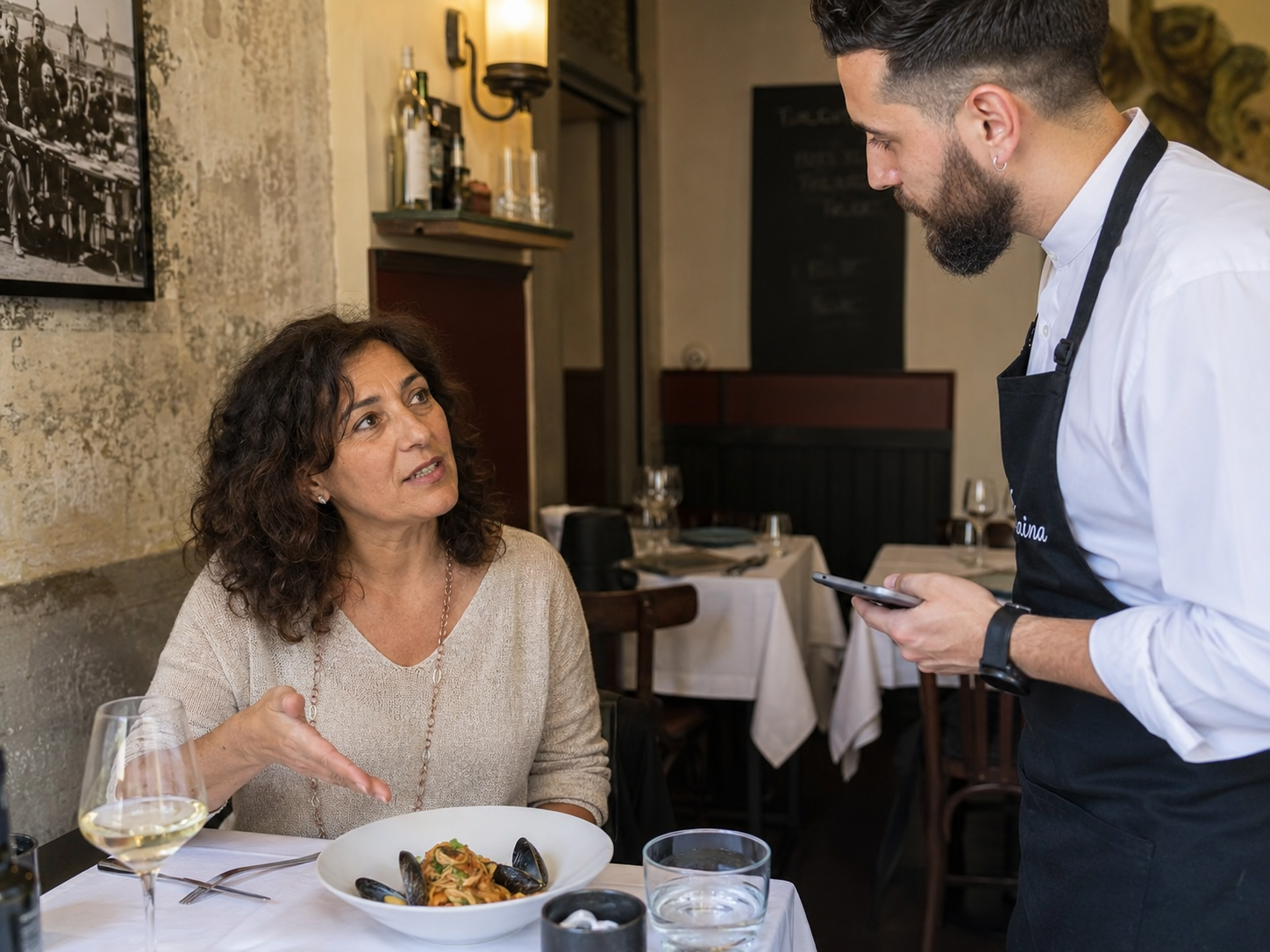
One of the first things travelers learn in Italian is no, grazie. It is simple, useful, and perfectly polite. The difficulty usually begins later, when the situation is not simply a matter of accepting or refusing a coffee. Perhaps the hotel gives you a room with one bed when you reserved two, a restaurant brings a dish with cheese even though you specifically asked for it without cheese, or a friend invites you to dinner on a night when you cannot go. Someone in a shop may keep showing you things you do not want, and you are trying to end the interaction politely without sounding irritated.
In situations like these, knowing the Italian word for “no” is not really the problem. The harder part is refusing something clearly while keeping the conversation comfortable enough to ask for what you actually want instead. I see this often with adult language learners. Some become so worried about sounding rude that they apologize repeatedly and never quite make the request. Others translate a very direct English sentence into Italian and are surprised when it sounds sharper than they intended. Italian gives you plenty of ways to be both clear and courteous, but the best choice depends on what you are refusing and what you want to happen next.
Sometimes no, grazie is exactly enough
The simplest polite refusal is also one of the most useful: no, grazie, meaning “no, thank you.” You can use it to decline another drink, refuse something in a shop, turn down an optional service, or respond to an uncomplicated offer. If someone asks, Vuole altro vino? (“Would you like more wine?”), No, grazie is a completely natural answer. The same is true if a salesperson asks, Vuole provare questo modello? (“Would you like to try this model?”).
Learners sometimes construct elaborate apologies because they worry that a plain no will sound rude, when no, grazie already does the job perfectly well. Tone matters, of course. A warm no, grazie sounds very different from a clipped no said impatiently, but you do not need elaborate politeness formulas for every small refusal.
Mi dispiace is useful when you genuinely regret saying no
When the refusal involves a social invitation or something you would have liked to accept, mi dispiace, meaning “I’m sorry,” can soften the answer naturally. If someone asks, Ti va di venire a cena sabato? (“Would you like to come to dinner Saturday?”), you might answer, Mi dispiace, sabato non posso (“I’m sorry, I can’t on Saturday”).
Here, mi dispiace does not mean you have done anything wrong. It expresses regret about the situation. English speakers often use “sorry” very broadly, and some learners carry that habit directly into Italian, beginning almost every refusal with mi dispiace even when nothing unfortunate has happened.
If a shopkeeper shows you something you do not want, for example, you do not necessarily need to say, Mi dispiace tantissimo, ma non credo che sia quello che sto cercando (“I’m very sorry, but I don’t think that’s what I’m looking for”). A more natural response may simply be, No, grazie. Cercavo qualcosa di più piccolo (“No, thank you. I was looking for something smaller”). You can have a preference without apologizing for it.
Non posso and non riesco are similar, but not identical
The straightforward way to say “I can’t” is non posso. By itself, however, it can sound abrupt in some social situations, especially when declining an invitation. A little context makes it warmer: Mi dispiace, stasera non posso (“I’m sorry, I can’t tonight”) or Stasera non posso, ma magari la prossima settimana (“I can’t tonight, but maybe next week”).
You will also hear non riesco, which can mean “I can’t manage” or “I’m not able to.” It works particularly well when circumstances make something difficult. Oggi non riesco a passare means “I can’t make it over today,” while Non riesco a venire prima delle otto means “I can’t manage to come before eight.”
Non posso often expresses inability more generally, while non riesco can suggest that you cannot manage something under the present circumstances. The distinction is not dramatic, but it is one of those small choices that makes everyday Italian sound more natural.
Sometimes you do not mean “I can’t.” You mean “I’d rather not.”
This is where preferirei becomes especially useful. Preferirei di no means “I’d rather not.” If someone suggests, Vuoi sederti fuori? (“Do you want to sit outside?”), you might reply, Preferirei di no, fa un po’ freddo (“I’d rather not; it’s a little cold”). You are not claiming that sitting outside is impossible. You simply prefer something else.
This becomes very practical when traveling. If a restaurant offers you a table you do not want, if a hotel proposes an inconvenient room, or if someone suggests a time that does not work well, you can state the alternative directly. Preferirei un tavolo dentro means “I’d prefer a table inside.” Vorrei una camera più tranquilla, se possibile means “I’d like a quieter room, if possible,” and Per me sarebbe meglio venerdì means “Friday would be better for me.” These sentences are polite without making your preference sound uncertain.
Offering another possibility can make a refusal easier
In social situations, an alternative can soften a refusal more naturally than a long apology. Non posso stasera, ma domani sì means “I can’t tonight, but tomorrow I can.” A quell’ora non riesco. Possiamo fare più tardi? means “I can’t make that time. Can we do later?” And Preferirei non andare lì. Che ne dici di questo posto? means “I’d rather not go there. What do you think about this place?”
If you genuinely want to see someone another time, saying so is often enough. You do not need to provide a detailed explanation for why Thursday at 7:30 has become impossible.
How to refuse more food without making it awkward
Food is one of the situations that makes learners unexpectedly nervous. A host offers another helping, you are already full, and suddenly you start wondering whether a refusal will sound ungrateful. Several simple expressions work well. You can say No, grazie, sono a posto (“No, thank you, I’m fine”), or No, grazie, sono pieno if you are a man and sono piena if you are a woman. Another natural option is Era buonissimo, ma non ce la faccio più (“It was delicious, but I really can’t eat any more”), or simply No, grazie, davvero (“No, thank you, really”).
In a warm social situation, someone may offer again simply because they want to make sure you have enough. A friendly but clear refusal is usually much easier than reluctantly accepting food you do not actually want.
When something is wrong, politeness should not hide the problem
This is where some learners become too indirect. Imagine arriving at a hotel and discovering that the room does not match your reservation. You booked two beds, but there is only one. A learner who is very worried about sounding demanding may say something like, Mi dispiace, forse mi sbaglio, non è un problema, però pensavo che forse… By the time the sentence reaches the actual issue, it is difficult to tell whether there is a problem at all.
A clearer version is, Mi scusi, credo che ci sia un errore. Avevo prenotato una camera con due letti. Potrebbe controllare, per favore? This means, “Excuse me, I think there’s a mistake. I had booked a room with two beds. Could you check, please?” It is polite, specific, and easy for the other person to respond to.
The same pattern works elsewhere. Mi scusi, credo che ci sia un errore means “Excuse me, I think there’s a mistake.” In realtà avevo chiesto… means “Actually, I had asked for…” Questo non è quello che avevo ordinato means “This isn’t what I ordered,” and Potrebbe cambiarlo, per favore? means “Could you change it, please?” I often find that students already know the vocabulary for these situations. The difficulty is that they become linguistically vague because they are afraid of sounding difficult. Clearly describing a mistake is not the same thing as being confrontational.
Mi scusi, ma… is one of the most useful polite corrections
Mi scusi, ma… means “Excuse me, but…” and is useful when you need to interrupt, correct a misunderstanding, or disagree politely. You might say, Mi scusi, ma credo che questo sia il nostro tavolo (“Excuse me, but I think this is our table”), Mi scusi, ma avevo chiesto senza formaggio (“Excuse me, but I had asked for it without cheese”), or Mi scusi, ma il conto non mi sembra corretto (“Excuse me, but the bill doesn’t seem correct to me”).
The sentences remain direct. The politeness comes from how the problem is introduced, not from pretending that the problem might not exist.
Preferirei and potrebbe make requests easier
Two forms that often make learners much more comfortable are preferirei and potrebbe. Preferirei means “I would prefer,” while potrebbe means “could you,” using the conditional form of potere. For example, Preferirei una camera ai piani alti means “I’d prefer a room on a higher floor.” Potrebbe portarmi un altro bicchiere, per favore? means “Could you bring me another glass, please?” and Potrebbe controllare la prenotazione? means “Could you check the reservation?”
Compare Può cambiarlo? (“Can you change it?”) with Potrebbe cambiarlo, per favore? (“Could you change it, please?”). Both can be polite, but potrebbe gives the request a little more distance. You do not need it in every interaction, but it is extremely useful when you want something changed without sounding abrupt.
Purtroppo can soften bad news without turning it into an apology
Another useful word is purtroppo, meaning “unfortunately.” You can say Purtroppo domani non posso (“Unfortunately, I can’t tomorrow”), Purtroppo non abbiamo tempo (“Unfortunately, we don’t have time”), or Purtroppo devo partire presto (“Unfortunately, I have to leave early”). You can even say Purtroppo no, which is a very natural way of saying “Unfortunately, no.”
This works well because it communicates regret while leaving the refusal completely clear. When declining an invitation, you might say, Mi farebbe molto piacere, ma venerdì non posso (“I’d really like to, but I can’t Friday”) or Venerdì non riesco, purtroppo. Magari un’altra volta (“I can’t make it Friday, unfortunately. Maybe another time”). Neither requires a long excuse.
Saying no in shops does not require a justification
Shopping is another place where learners sometimes feel they need to explain themselves. If you are browsing, Sto solo guardando, grazie means “I’m just looking, thank you.” If you are not interested, you can say No, grazie, non mi interessa (“No, thank you, I’m not interested”). If you want something different, Cerco qualcosa di diverso means “I’m looking for something different,” while È bello, ma cercavo qualcosa di più semplice means “It’s nice, but I was looking for something simpler.”
You do not have to invent a reason for not buying something. Saying what you are looking for is often more useful anyway.
Restaurants require clarity when the order is wrong
Suppose you ordered fish and received meat. You can say, Avevo chiesto il pesce, non la carne (“I had ordered the fish, not the meat”). If you asked for a dish without cheese, Scusi, questo piatto dovrebbe essere senza formaggio means “Excuse me, this dish should be without cheese.” You can then ask, Potrebbe portarmi quello che avevo ordinato? (“Could you bring me what I ordered?”).
A very useful pattern is to begin with Mi scusi or Scusi, give a factual explanation, and then make a concrete request. For example, Mi scusi, avevo ordinato il pesce. Potrebbe cambiarlo, per favore? There is nothing aggressive about this. You are simply giving the other person enough information to solve the problem.
The same language works in hotels, trains, and reservations
Travel produces plenty of similar situations. At a hotel, you might say, Avevo prenotato una camera tranquilla. Ce n’è un’altra disponibile? (“I had booked a quiet room. Is another one available?”). On a train, Mi scusi, credo che questo sia il mio posto means “Excuse me, I think this is my seat.” If a reservation time is wrong, you can say, No, avevo prenotato per le otto, non per le nove (“No, I had booked for eight, not nine”). With transportation, Preferirei andare direttamente in hotel, grazie means “I’d prefer to go directly to the hotel, thank you.”
Students are sometimes surprised by how little special vocabulary these situations require. Once they become comfortable with mi scusi, preferirei, potrebbe, and a few factual explanations, the interactions become much easier.
Formal and informal Italian matter too
Italian allows you to adjust politeness through the distinction between informal tu and formal Lei. With someone you know well, you might say Puoi cambiarlo? (“Can you change it?”). In a formal interaction, the equivalent is Può cambiarlo?, and a slightly more courteous version is Potrebbe cambiarlo, per favore? (“Could you change it, please?”).
For travelers, service situations are a good place to become comfortable with formal forms such as mi scusi, può, and potrebbe. They do not make the conversation excessively formal; they simply create an appropriate degree of distance between people who do not know each other.
Why some learners apologize too much
One pattern I see repeatedly with adult learners is that the grammar is perfectly correct while the request becomes unnecessarily hesitant. A student may produce something like, Mi dispiace, forse sarebbe possibile, non so, magari avere un altro tavolo? The intention is very polite, but the result sounds as though the speaker is not sure whether they actually want another table.
A clearer version is, Mi scusi, preferiremmo un altro tavolo, se possibile (“Excuse me, we’d prefer another table, if possible”). The same thing happens with forse, meaning “perhaps” or “maybe.” It is useful when something really is uncertain, but if your hotel reservation clearly says two beds and the room clearly has one, you do not need to make the issue sound hypothetical. Mi scusi, avevo prenotato una camera con due letti is enough to begin.
Other learners make the opposite mistake
Direct translation can create the reverse problem. A learner might say, No. Voglio questo (“No. I want this”) or Dammi un altro (“Give me another one”). Depending on the situation, these can sound abrupt.
More natural alternatives might be No, grazie. Preferirei questo (“No, thank you. I’d prefer this”), Potrebbe portarmene un altro, per favore? (“Could you bring me another one, please?”), or Mi scusi, questo non va bene. Potrebbe cambiarlo? (“Excuse me, this isn’t right. Could you change it?”). The information stays clear, but the social tone changes.
Sometimes a direct no is the right answer
Indirectness is not automatically more polite. If the issue involves allergies, health, safety, persistent sales pressure, unwanted attention, or a serious misunderstanding, clarity matters more than softening every sentence.
No, grazie is enough in many situations. If food is involved, you might need to say, No, non posso mangiarlo. Sono allergico alle noci if you are a man, or Sono allergica alle noci if you are a woman: “No, I can’t eat it. I’m allergic to nuts.” In another situation, No, questo non va bene means “No, this isn’t okay,” while No, grazie, non mi interessa means “No, thank you, I’m not interested.”
If the other person needs to understand that the answer is definitely no, do not bury it inside three layers of politeness.
A quick guide to choosing what to say
Situation Useful Italian
Simple refusal No, grazie.
Regretful refusal Mi dispiace, non posso.
Expressing preference Preferirei…
Suggesting a better option Per me sarebbe meglio…
Polite correction Mi scusi, credo che ci sia un errore.
Declining an invitation warmly Mi farebbe piacere, ma…
Unfortunately not Purtroppo no.
Firm refusal No, grazie, non mi interessa.
The useful question is not simply “How do I say no?” but what kind of refusal you are making. Declining another glass of wine, correcting a hotel reservation, and refusing an invitation are three different social situations, even if all of them contain some version of no.
This is why I think this topic deserves more attention than it usually receives in phrasebooks. Learners often already know the grammar they need. What they have not practiced is using it when there is a real social consequence: telling someone that the table is wrong, declining an invitation without sounding cold, or refusing food for the second time. Role-playing situations like these in class can be surprisingly useful because students begin to see that politeness is not one magic phrase. It comes from the combination of wording, register, tone, and clarity.
For learners who want more practice with everyday interactions like these, Polyglottist Language Academy offers Italian classes for adults where grammar and vocabulary are practiced through real conversation, including requests, invitations, restaurants, travel situations, and formal versus informal speech. ITALIAN CLASSES AT POLYGLOTTIST ITALIAN CLASSES