
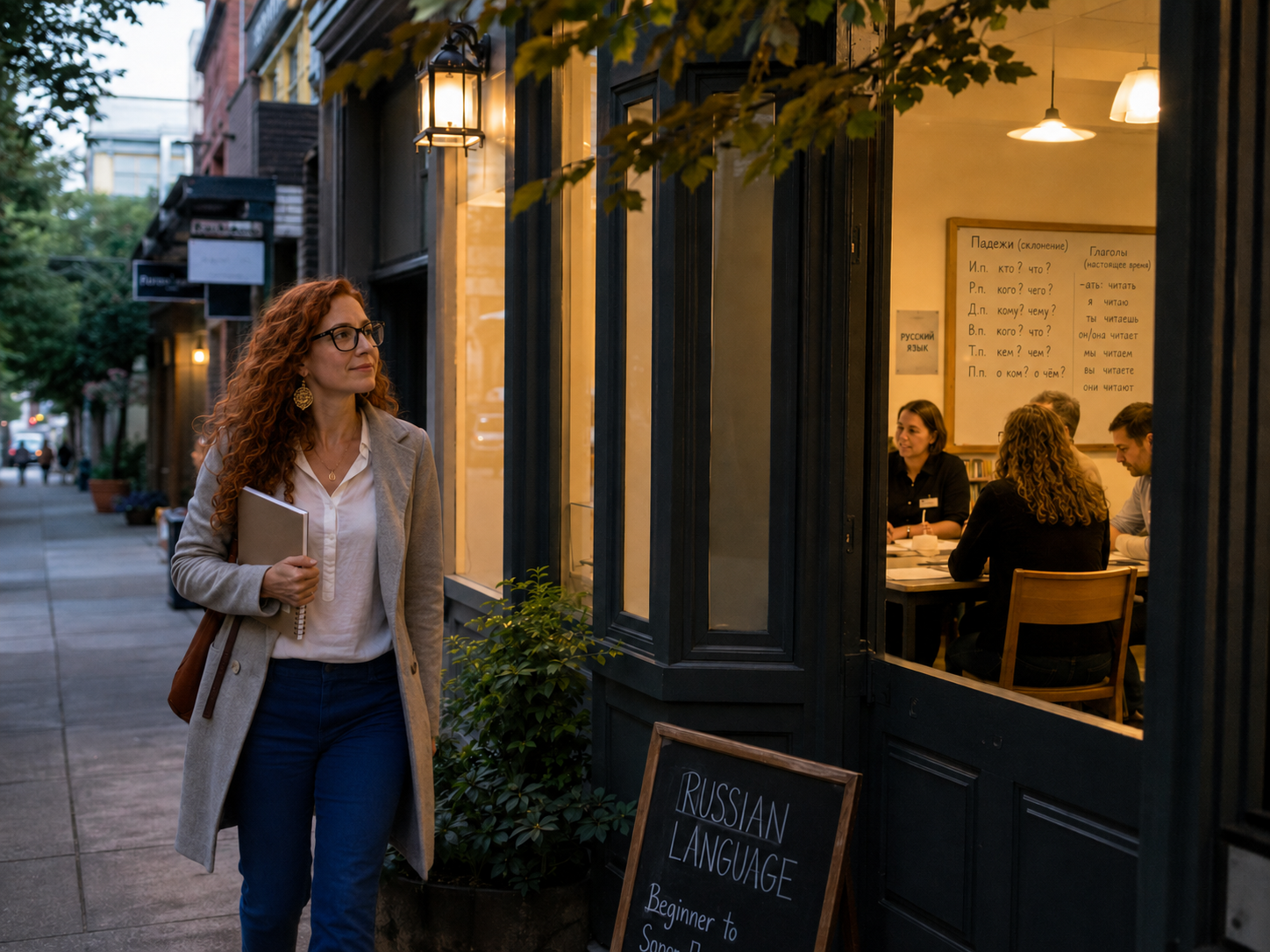
Typing “Russian classes near me” into Google seems like a straightforward way to find a course. Then the results appear.
One listing is for a private tutor. Another is a heritage program for children. A university course sits beside a self-paced online program, a language school, a conversation group, and several apps that are not really classes at all. Some courses expect students to know Cyrillic already, while others begin from the alphabet. A class described as “beginner” may turn out to be intended for people who can already hold a basic conversation.
For adults, finding a Russian class is therefore less about choosing the closest result and more about figuring out what kind of instruction will actually fit your level, schedule, and way of learning.
That matters with Russian because the language benefits from structure. Vocabulary and grammar need to build gradually, pronunciation deserves attention from the beginning, and students need opportunities to use what they are learning rather than simply recognize it on a page.
What Does “Russian Classes Near Me” Really Mean?
For someone living in Berkeley or Oakland, an in-person Russian class in Berkeley may genuinely be convenient. It can fit into an ordinary week without turning a one-hour lesson into an evening devoted largely to commuting.
For someone coming from San Francisco, Marin, the Peninsula, or farther into the East Bay, the calculation can be very different. A class that looks reasonably close on a map may become much less practical once traffic, BART connections, parking, and the trip home are included.
Adults sometimes underestimate how much this matters. A class may look ideal when you register, but if attending it requires reorganizing your entire evening every week, consistency becomes harder.
The best class “near you” might therefore be near home, near work, easy to reach by public transportation, or live online. What matters is not simply distance but whether the format is realistic enough that you will keep attending.
For some students, being physically present in a classroom is worth the commute. Others know that after a full workday, joining a live online class from home is much more sustainable. Both can work well when the instruction itself is strong.
“Beginner” Can Mean Almost Anything
One of the more interesting things Russian teachers encounter is how differently adult students arrive at the same level label.
A complete beginner may know no Russian at all and have never seen Cyrillic.
Another student may have used an app for eight months and can recognize hundreds of words but has almost no experience creating an original sentence.
Someone who took Russian in college fifteen years ago may still remember surprisingly specific grammar. It is entirely possible to remember that the instrumental plural often ends in -ами or -ями while momentarily forgetting an everyday word such as “fork.”
Then there are heritage learners. One person may understand a Russian-speaking grandparent almost effortlessly but answer in English. Another may speak quite naturally at home yet read slowly and have no idea what the grammatical cases are called.
All of these people may reasonably describe themselves as beginners.
That is why placement works better when students describe what they can currently do rather than simply reporting how long they studied.
Can you read Cyrillic? Can you introduce yourself? Can you understand basic questions? Have you studied Russian cases? Can you talk about something that happened yesterday? If someone you do not know speaks Russian to you, can you follow them, or do you mainly understand relatives whose voices and expressions are familiar?
Those answers reveal much more than “I took two years of Russian.”
Russian Grammar Matters, but It Has to Go Somewhere
Russian grammar has a formidable reputation, and not entirely without reason. English-speaking learners encounter six cases, adjective agreement, verb conjugations, verbal aspect, verbs of motion, and a degree of word-order flexibility that can initially create more questions than freedom.
Adults often appreciate having the system explained clearly. There is no reason to pretend Russian grammar will somehow disappear if the class is sufficiently conversational.
The more useful question is what happens after the explanation.
Suppose students are learning the prepositional case. They need to understand when it is used and what happens to common noun endings. After that, however, the grammar should begin appearing in language they actually need: where they live, where they work, where they studied, which city they are in, or where someone is traveling.
At first, a learner may mentally assemble the sentence piece by piece. Which case? Which ending? Is the adjective changing too? What happened to the preposition?
With repetition, familiar patterns begin to come more quickly.
Russian teachers often see students who perform beautifully on written grammar exercises and then avoid the same construction while speaking because retrieving the correct form takes too long. That is not a contradiction. Written accuracy and spontaneous use are different stages of learning.
There is also a tendency among English speakers to translate too literally. Russian may omit something English normally requires or organize the sentence in a way that feels unusual at first. Flexible word order adds another layer: several arrangements may be grammatically possible, but they do not necessarily sound equally natural or emphasize the same information.
Those distinctions are difficult to learn from grammar tables alone.
Speaking Russian Does Not Mean Being Thrown Into the Deep End
Some adults hear “conversation-based class” and imagine being placed in a room where the teacher speaks rapid Russian from the first minute and everyone is expected to survive.
That is not the only way to make a course communicative.
For a complete beginner, speaking can begin with very controlled language: introductions, simple questions, family, where you live, what you like, basic schedules, food, or familiar activities. The vocabulary may be modest, but students are already choosing what to say rather than only reading someone else's answer.
A useful distinction appears with a sentence as simple as:
Я живу в Беркли.
Ya zhivu v Berkli.
“I live in Berkeley.”
Reading that sentence and understanding it is one skill. Hearing Где вы живёте? (Gde vy zhivyote? — “Where do you live?”) and producing the answer yourself is another.
Students who have studied independently sometimes find this frustrating at first. They recognize everything the teacher says and assume they should therefore be able to answer easily. Then the vocabulary seems to disappear the moment they need it.
It has not disappeared. Recognition simply developed before retrieval.
The way out of that problem is not another hundred recognition exercises. It is repeated practice using the language.
The Alphabet Usually Stops Being Scary Before Pronunciation Does
Complete beginners often expect Cyrillic to be their biggest problem.
It certainly looks unfamiliar at first. Some letters are genuinely new, while others are more mischievous because they look familiar but represent a different sound. Russian Р represents r, while Н represents n. During the first few lessons, the brain keeps trying to read them as English letters.
Fortunately, Cyrillic is usually a shorter-term difficulty than students expect. With regular practice, adults can often begin reading straightforward Russian words fairly quickly.
Pronunciation takes longer because spelling does not tell the whole story.
Russian word stress is not always predictable, and unstressed vowels change their pronunciation. A learner may therefore read a word correctly letter by letter and still say it in a way that sounds unfamiliar to a Russian speaker because the stress falls on the wrong syllable.
Hard and soft consonants introduce another distinction that English speakers do not naturally listen for. Students may initially hear two Russian sounds as essentially identical even though native speakers perceive a clear difference.
Teachers also notice another funny stage in pronunciation development: once students realize Russian has unfamiliar sounds, some begin pronouncing every syllable with enormous care. Each sound becomes a separate project, and the sentence loses all rhythm.
As learners become more comfortable, pronunciation shifts from “Can I make this individual sound?” toward stress, rhythm, and how an entire phrase moves.
That is much easier to develop when someone can hear you and respond immediately.
What a Teacher Can Notice in Thirty Seconds
One reason live instruction can be useful is that a teacher does not only hear individual mistakes. Over time, patterns become visible.
A student may know a great deal of vocabulary but construct nearly every sentence in an English-shaped way.
Another may have excellent reading skills and consistently misplace word stress.
A returning learner may remember the terminology for advanced grammar while struggling to ask a simple follow-up question.
A heritage speaker may sound completely natural while talking about food, family, or childhood and then suddenly become hesitant when the subject moves to work, politics, travel, or an abstract opinion.
Someone else may speak quite freely but repeatedly avoid a particular grammatical structure because they are not confident about the endings.
These problems look different from one another even when two students score similarly on a placement test.
That is also why good correction is more than saying “wrong” and supplying the right form. Sometimes a student needs a rule explained. Sometimes they already know the rule and simply need repeated use. Sometimes the grammar is acceptable but the phrasing is unnatural. Sometimes pronunciation is the real obstacle.
The value of a teacher lies partly in distinguishing among those situations.
Apps Are Useful. They Just Do a Different Job.
Many adults come to a Russian class after spending months with an app, textbook, YouTube channel, podcast, or flashcard system.
That time is not wasted.
Apps can be excellent for vocabulary repetition. Flashcards help because a large amount of vocabulary simply has to be remembered. Textbooks provide systematic explanations that students can revisit slowly. Podcasts and videos increase exposure to spoken Russian beyond what is possible in a weekly class.
The trouble begins when passive familiarity starts to feel like active ability.
If an app shows собака (sobaka) and you immediately know that it means “dog,” that is useful. Retrieving собака during a conversation is a slightly different mental task.
The same applies to grammar. Selecting the correct form from four choices is easier than producing that form when nobody has shown you the choices.
A combination often works best: structured classes for interaction, correction, and progression, with independent study providing the repetition that no teacher can fit into one hour a week.
Group Classes, Private Lessons, and Other Options
People searching for Russian instruction often encounter several formats at once, and there is no single correct choice.
Private lessons offer obvious advantages. The teacher can focus on one student, adjust the pace immediately, work around unusual gaps, and tailor lessons to a specific goal. This can be particularly useful for a returning learner, a heritage speaker with uneven skills, or someone preparing for a specialized situation.
Group classes offer something private instruction cannot reproduce quite as easily: other learners.
Another student may ask a question you never thought to ask. They may use a word you forgot or misunderstand what you said, forcing you to try a different explanation. You hear several voices rather than only the instructor's. Conversation becomes slightly unpredictable.
That unpredictability is useful because real Russian speakers will not organize their responses around the vocabulary list you studied that week.
University and community programs can also be excellent options. Some provide especially strong academic structure, although schedules, semester systems, pacing, or enrollment requirements may not suit every working adult. Community and cultural programs vary widely; some focus on conversation, while others may be designed primarily for heritage-speaking children.
The important question is not which category is “best.” It is who the course was designed for and whether that matches the way you need to study.
Learning Russian in Berkeley
For adults in Berkeley, Oakland, and nearby East Bay communities, studying Russian in person has some straightforward advantages.
After spending an entire workday on a screen, some people simply prefer sitting in a room with other human beings. Conversation has a different rhythm when facial expressions, gestures, small interruptions, and reactions are all happening naturally around a table.
A physical class also creates a regular appointment with Russian. Independent study is remarkably easy to postpone. You plan to review vocabulary after dinner, something comes up, and suddenly three days have passed.
A weekly class puts a boundary around that time.
Berkeley also attracts the sort of adult learner who may be studying Russian without an immediately practical reason. Some students come through literature or history. Others have family connections, travel interests, relationships, or a broader fascination with languages. Some simply enjoy tackling a language whose structure differs dramatically from English.
Those motivations can coexist comfortably in an adult group.
Bay Area geography still matters, though. Someone living in Berkeley or Oakland may find an evening class easy enough to attend. Someone coming across the Bay from San Francisco after work may reach a different conclusion once commuting time becomes part of the equation.
There is nothing particularly virtuous about choosing the in-person option if it makes regular attendance unnecessarily difficult.
When Online Russian Classes Make More Sense
Live online classes can work extremely well when students are expected to participate rather than simply watch.
A teacher can still correct pronunciation, ask follow-up questions, explain grammar, and listen to students build sentences. Classmates can talk to one another. Written Russian can be placed on screen immediately, which is sometimes useful when discussing stress, endings, or sentence structure.
For Russian in particular, being able to type out two forms side by side or mark the stressed syllable while students are looking at the word can be quite practical.
Online classes can also open a group to learners who would never be able to commute to Berkeley every week. Someone may live elsewhere in California, another state, or simply far enough across the Bay Area that a weekly trip is unrealistic.
The screen does not determine whether a class is passive. Teaching does.
A live online course in which students spend a meaningful amount of time talking, listening, and responding can be far more interactive than an in-person class built almost entirely around a teacher's lecture.
Returning to Russian Is a Strange Experience
Adults who come back to Russian after a long break often expect either to remember everything or nothing.
Usually, neither happens.
Grammar may return before vocabulary. Reading may feel surprisingly comfortable while listening seems impossibly fast. A student may look at a declension and think, “Of course,” then spend ten seconds trying to remember how to say “Wednesday.”
This uneven recovery is normal.
Returning learners do not necessarily need to start again from the alphabet, but they may need time to reactivate knowledge that has been dormant for years. The right level is often one that provides enough familiar material to rebuild confidence without spending six weeks reviewing things that are already solid.
This is another case where discussing actual abilities with the school is more useful than relying on the label of the last course taken years ago.
Heritage Learners Often Need a Different Kind of Placement
Heritage Russian learners may have the most uneven profiles of all.
Someone can understand a parent perfectly and struggle to answer. Another person may speak comfortably but read slowly. Some heritage speakers have excellent pronunciation and intuitive grammar but limited adult vocabulary because most of their Russian developed around family life.
Others know expressions that sound completely natural but cannot explain why the endings are correct.
A traditional grammar test does not always capture this well.
A heritage learner might score poorly on formal grammatical terminology despite communicating quite effectively, or perform very well on listening while finding even simple writing difficult.
For these students, the goal is often less about “starting Russian” and more about strengthening the areas that never developed fully.
That makes careful placement particularly important.
Learning Russian with Polyglottist Language Academy
At Polyglottist Language Academy, we work specifically with adult language learners, so many of the situations described above are familiar. One student may be beginning Russian from zero, another may be returning after college, while a heritage learner understands far more Russian than they feel comfortable speaking.
Our Russian classes are structured so that grammar and vocabulary develop progressively, but the purpose is not simply to accumulate rules. Students also need opportunities to listen, speak, ask questions, receive feedback, and gradually become more comfortable using Russian in real time.
Depending on the current schedule, Polyglottist offers Russian classes in Berkeley as well as live online options for students who live farther away or prefer studying from home.
If you are unsure about your level, especially if you studied Russian in the past or grew up hearing it, describing your current strengths and weaknesses is usually more helpful than choosing a class based only on the number of years you once studied.
View current Russian classes at Polyglottist Language Academy
The first Google search may have been for “Russian classes near me,” but distance is only one part of choosing well. The class also needs to be at the right level, fit realistically into your week, and give you enough chances to use the language for what you learn to become active.
Eventually, that change shows up in an ordinary moment. Someone asks you a question in Russian and, instead of understanding every word while your mind frantically searches for a response, you simply answer.
That is when Russian starts to feel less like material you have studied and more like a language you actually know how to use.