
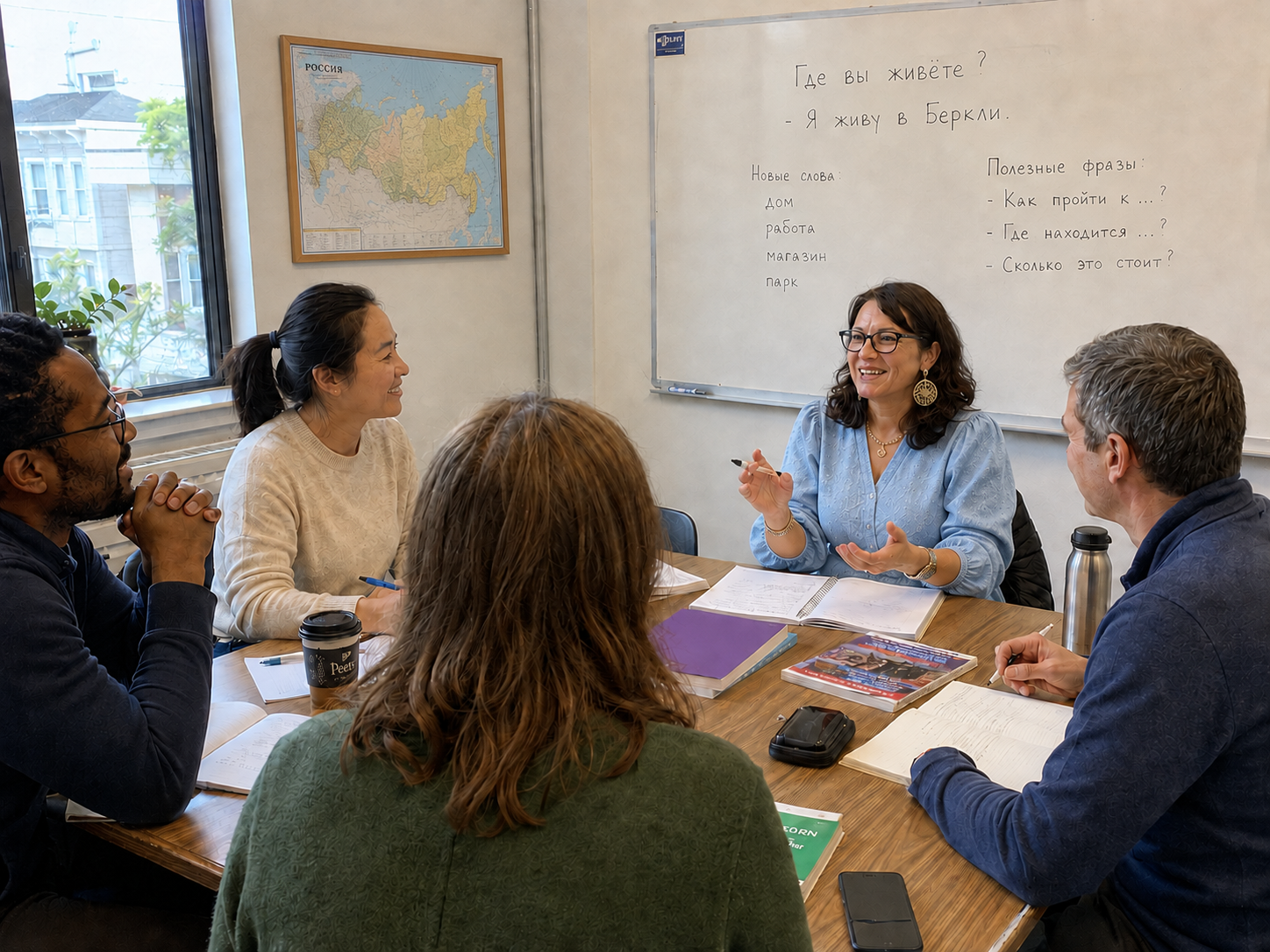
A student can spend several weeks learning the Russian alphabet, memorizing vocabulary, and working through grammar exercises, then discover something surprising the first time another person asks a simple question in Russian: knowing the words and answering the question are two very different skills.
This happens often in language learning, but Russian makes the difference particularly noticeable. You may know that Я живу в Беркли (Ya zhivu v Berkli) means “I live in Berkeley.” You may understand every word in the sentence and even know why the forms look the way they do. Yet when someone asks Где вы живёте? (Gde vy zhivyote? — “Where do you live?”), producing the answer without translating everything mentally can suddenly feel much harder.
That gap between recognizing Russian and actually using it is one of the main reasons live, interactive instruction can be so valuable. Learning Russian is not simply a matter of accumulating grammar rules and vocabulary. At some point, the language has to become something you can use with another person.
For adults looking for Russian classes in Berkeley, Oakland, elsewhere in the Bay Area, or online, this is also a useful way to think about what makes a class genuinely engaging. “Fun” does not have to mean games or entertainment. For many adults, the enjoyable part is being intellectually engaged, talking to other people, understanding something that once seemed completely opaque, and realizing that Russian is gradually becoming usable.
What Does an Interactive Russian Class Actually Look Like?
The word “interactive” appears so often in descriptions of language courses that it can become almost meaningless. In practice, an interactive Russian class is simply one in which students regularly have to understand and produce Russian rather than spend the entire lesson listening to explanations.
For a complete beginner, the interaction may initially be quite simple. Students might introduce themselves, say where they live, talk about the languages they speak, describe their families, or ask classmates basic questions. The vocabulary is limited, but something important is already happening: the student has to choose words and grammatical forms in response to another human being.
As students progress, those conversations become less predictable. They may talk about what they did over the weekend, describe travel plans, explain what they like to cook, compare cities they have visited, or respond to another student's opinion. At higher levels, conversation can naturally expand into literature, films, history, culture, or whatever topics interest the group.
The exact activity is less important than the fact that the learner has to listen, understand, decide what to say, and construct a response.
That small amount of unpredictability matters. An app usually presents a question for which it already has a fixed answer. Another person does not.
Russian Grammar Needs to Be Used, Not Just Memorized
Russian understandably has a reputation for grammar. English-speaking learners encounter grammatical gender, changing noun endings, verb conjugations, verbal aspect, and a case system that can initially make a textbook page look more intimidating than the language actually feels in conversation.
Charts help. Explanations matter. Russian grammar does require conscious study.
The problem is that understanding a rule is only the first stage.
A learner may know perfectly well that Russian nouns change their endings depending on their role in the sentence. On a worksheet, with time to think, choosing the correct ending may feel manageable. During conversation, there are only a few seconds to decide what to say.
At first, a beginner may mentally reconstruct the rule before speaking. Later, familiar structures begin to come as complete patterns. Instead of working through every grammatical step required to say “I live in San Francisco,” the learner gradually starts experiencing Я живу в Сан-Франциско (Ya zhivu v San-Frantsisko) as a single usable expression.
Teachers often notice the same pattern with adjectives and verbs. A student can recite a conjugation correctly and still hesitate when asked an unexpected question. Another may understand adjective endings perfectly on paper but pause for several seconds when describing an actual person.
Russian learners also frequently try to translate too literally from English. That is understandable, especially at the beginning, but languages do not always organize information in the same way. Russian may omit something English requires, phrase an idea differently, or place words in an order that feels unusual to an English speaker even though it sounds completely natural in Russian.
Live practice helps learners encounter those differences repeatedly rather than treating grammar as a system that exists only in exercises.
The goal is not to stop thinking about grammar altogether. It is to reach the point where you no longer have to consciously reconstruct every rule before you can say something simple.
The Alphabet Is Usually Not the Hardest Part
Many complete beginners approach Russian assuming that Cyrillic will be their biggest obstacle.
It looks formidable at first, especially because several letters resemble English letters while representing different sounds. The Russian letter Р, for example, represents an r sound, while Н represents n. For the first few lessons, familiar-looking letters can feel strangely unreliable.
Fortunately, Cyrillic is usually a smaller obstacle than students imagine. With regular practice, adults can often begin reading Russian words relatively quickly.
Pronunciation takes longer.
Russian word stress is not always predictable, and the position of the stress affects how vowels are pronounced. Unstressed vowels may sound quite different from what the spelling initially suggests. The distinction between hard and soft consonants can also be difficult for English speakers to hear, much less produce consistently.
This is one reason a Russian word can look perfectly manageable on the page and still sound surprising when a native speaker says it naturally.
A teacher can demonstrate the difference, listen to the student, make a small correction, and have the student try again. That immediate feedback is difficult to reproduce through reading alone.
There is another common beginner habit as well: focusing so intensely on producing every Russian sound correctly that the sentence loses its natural rhythm. Over time, pronunciation becomes less about attacking each sound individually and more about stress, rhythm, and how the sounds connect in ordinary speech.
What Makes a Russian Class Enjoyable for Adults?
Adult learners generally do not need Russian lessons disguised as children's entertainment.
The enjoyable part of a good class often comes from intellectual satisfaction.
There is a particular pleasure in suddenly recognizing a phrase in a film that would previously have sounded like an uninterrupted stream of sounds. The same thing happens when a grammatical pattern that once required careful calculation begins appearing automatically.
Conversation itself makes the class more interesting because the answers are real.
If students are practicing vocabulary for food, for example, they do not have to repeat the same scripted restaurant dialogue several times. Once they have enough language, they can ask one another what they actually like to eat, what they cook, what they dislike, or what they would order.
The grammar is still being practiced, but now it is attached to meaning.
This works particularly well with adults because they arrive in class with genuine interests and very different reasons for studying Russian. One student may be fascinated by Russian literature. Another may have family connections. Someone else may be learning because of travel, history, a partner, music, or simply curiosity about a language that works very differently from English.
A class becomes more engaging when Russian gradually turns into a way of talking about those interests rather than remaining a set of exercises that exists only inside a textbook.
Mistakes are part of that process. Many adults are reluctant to speak until they are reasonably certain the sentence will be correct, and Russian gives them plenty of things to worry about: a case ending, a verb form, stress, pronunciation, or word order may all feel questionable at once.
Waiting until everything is perfect is not very helpful, though. Students need opportunities to attempt a sentence, discover what worked, correct what did not, and try again. Some mistakes deserve immediate attention; others can wait until the learner has finished the thought. Good instruction involves knowing the difference.
Learning Russian With Other Adults
Group classes introduce something independent study cannot easily provide: other learners.
When you practice with an app, you usually know roughly what kind of answer it expects. When another student speaks, you do not.
Someone may use a word you forgot, pronounce something differently from the way you expected, or answer a question in a direction you had not anticipated. Now you have to listen for meaning rather than simply confirm information you already know.
Students also learn from one another's questions. One person may ask about a grammatical pattern several others had noticed but could not explain. Another may make a common mistake that helps the whole group understand the underlying rule.
There is also something reassuring about learning Russian alongside other adults who are dealing with the same peculiarities. Everyone eventually mixes up an ending, forgets where the stress falls, or knows exactly what they want to say but cannot retrieve the word quickly enough.
That is normal language learning, not failure.
Apps and Self-Study Still Have an Important Place
Apps, textbooks, podcasts, videos, and independent study can all be useful.
An app may be excellent for reviewing vocabulary during a commute. A textbook can provide a systematic grammar explanation that students can return to slowly. Podcasts and videos offer additional listening exposure. Flashcards are helpful for vocabulary that simply needs repetition.
The problem appears when recognition is mistaken for active ability.
Seeing the Russian word собака (sobaka, “dog”) and selecting the correct translation is different from retrieving собакаduring a conversation. Understanding a model sentence is different from constructing your own. Recognizing the correct grammatical form among four choices is different from producing it when nobody has provided those choices.
There is also a familiar moment for app users: a sentence appears on the screen and seems completely obvious, yet if someone asks you to say the same thing from scratch thirty seconds later, the words suddenly disappear.
For many adults, the most effective approach is a combination. Independent study provides repetition and additional exposure, while live classes provide structure, interaction, correction, and the slightly uncomfortable but necessary experience of having to produce Russian yourself.
Not Every “Beginner” Is the Same Kind of Beginner
One of the challenges in placing adults into Russian classes is that language knowledge is rarely distributed evenly.
Someone who studied Russian at university fifteen years ago may remember Cyrillic and much of the grammar but struggle with ordinary conversational vocabulary.
Another student may have used an app for a year and recognize hundreds of words while having very little experience creating original sentences.
A heritage learner might understand Russian spoken by parents or grandparents but find it difficult to answer. Another heritage speaker may converse easily at home yet have weak reading skills and little formal understanding of grammar.
Then there are learners who taught themselves Cyrillic before class and can read aloud quite confidently even though they know almost no Russian.
These students could all describe themselves as “beginners,” yet putting them into exactly the same learning situation may not work particularly well.
When you are unsure about your level, it is often more useful to describe what you can actually do than to guess whether you are A1, A2, beginner, or intermediate.
Can you read Cyrillic? Can you introduce yourself? Can you talk about yesterday? Can you understand basic questions without translating every word into English? Have you studied the Russian cases? Can you hold even a simple conversation?
Those answers usually tell a teacher much more.
Learning Russian in Berkeley
For adults in Berkeley, Oakland, and the surrounding East Bay, studying Russian in person has some obvious advantages. After spending much of the day looking at screens, some students simply enjoy sitting in a room with other people and speaking face to face.
Conversation has a different rhythm in person. Facial expressions, gestures, interruptions, small reactions, and the ordinary back-and-forth around a classroom table all contribute to communication.
A regular in-person class can also create useful accountability. Adults have jobs, families, travel schedules, and dozens of competing demands on their time. Having a fixed hour each week for Russian makes it easier to keep the language from becoming something you continually intend to return to “when things calm down.”
In the Bay Area, however, geography matters.
Someone who lives in Berkeley or Oakland may find an evening class relatively easy to attend. A student commuting from San Francisco, Marin, the Peninsula, or farther into the East Bay may look at traffic, BART connections, and the time involved and quite reasonably decide that an online class fits better.
That is not a small consideration. A theoretically wonderful class is not particularly useful if getting there every week becomes exhausting.
Berkeley also tends to attract adults who learn languages for reasons that are not always purely practical. Students may come to Russian through literature, history, academic interests, travel, family background, or simple intellectual curiosity. Russian rewards that kind of curiosity because even beginner-level study quickly reveals how differently the language organizes ideas from English.
And Beyond Berkeley: Can Russian Be Learned Effectively Online?
Yes. The quality of an online class depends much more on how it is taught than on the fact that it takes place on a screen.
A live online Russian class can still include conversation, pronunciation work, direct teacher feedback, grammar practice, and interaction with classmates. Students can answer questions, adapt dialogues, discuss material, and practice speaking in real time.
Online learning can even have practical advantages for Russian. A teacher can display a word with its stress clearly marked, show different case endings side by side, or type out a sentence while discussing why one version sounds more natural than another.
The real problem is not online versus in person. It is spending an hour passively listening instead of using the language.
An online class in which students are regularly talking and responding can be far more useful than an in-person course in which they mostly watch the teacher explain grammar.
For someone who lives near Berkeley, the social experience of an in-person class may still be preferable. For someone farther away, joining a live Russian course without adding a long commute may make consistent study much easier.
What Should You Look for in an Adult Russian Class?
When comparing courses, descriptions such as “fun,” “dynamic,” and “immersive” do not tell you very much.
It is more useful to consider what students actually do.
Are they speaking Russian regularly, even at the beginner level? Does the teacher explain why something works rather than simply correcting the answer? Is pronunciation addressed? Are students expected to create their own sentences? Is there enough structure for grammar and vocabulary to build from one week to the next?
The appropriate balance will vary from student to student.
Some adults genuinely enjoy grammar and want to understand the system in detail. Others understand the rules perfectly well but need a teacher to make them stop analyzing and start speaking. Heritage learners may need a different combination of reading, grammar, vocabulary, and conversation from students beginning Russian from zero.
A good class does not make the difficult parts of Russian disappear. It gives students enough explanation to understand what is happening and enough practice for that knowledge to become useful.
Russian Classes at Polyglottist Language Academy
Because Polyglottist Language Academy works with adult language learners, our Russian classes are built around this balance between understanding the language and actually using it. Russian does require structure, especially as students begin working with cases, verb forms, and more complex sentences, but explanation alone is not enough. Students also need regular opportunities to speak, listen, ask questions, and become more comfortable producing Russian in real time.
Depending on the current schedule, we offer Russian classes for adults in Berkeley as well as live online options for students who live farther away or simply prefer studying from home.
If you studied Russian in the past, learned independently, or grew up hearing Russian and are uncertain which class would suit you, it is often worth thinking about your actual skills rather than relying on the label you used years ago. Reading, listening, grammar, and speaking do not always develop at the same pace.
View current Russian classes at Polyglottist Language Academy
The difference between studying Russian and speaking Russian often appears in very ordinary moments. Someone asks where you live, what you did yesterday, what food you like, or where you would like to travel, and you realize that you can answer without mentally assembling every piece of the sentence first.
That ability does not come from memorizing one perfect grammar chart. It develops through many small conversations, until Russian begins to feel less like something you are solving and more like something you can actually use.