
The Tragic Life of Marina Tsvetaeva — And Her Beautiful, Brutal Poetry
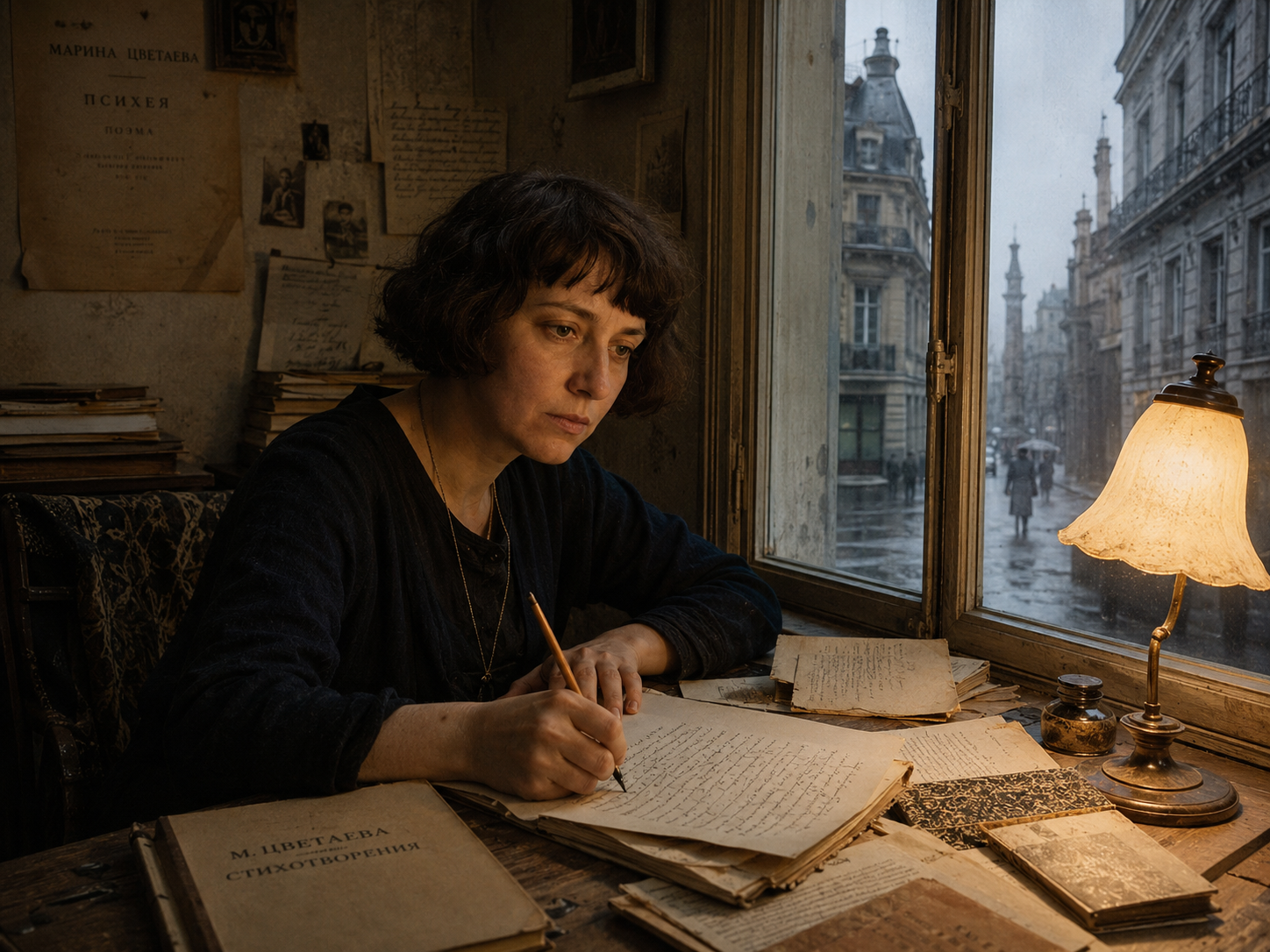
A dash in a Marina Tsvetaeva poem rarely behaves like ordinary punctuation. It can interrupt a confession, reverse an emotion, accuse an absent lover, or open a silence too large for the sentence containing it. Read aloud, her poetry often seems to run ahead of the human voice and then stop abruptly, as though language itself has reached the edge of what it can bear.
That sound—the urgent line, the displaced stress, the thought breaking open—is one reason Tsvetaeva remains unlike almost any other Russian poet.
Her biography is filled with the catastrophes of the twentieth century: revolution, civil war, famine, exile, political persecution, family separation, and the destruction of nearly every form of security she possessed. Yet it would be a mistake to treat her poetry as a dramatic footnote to her suffering. Tsvetaeva’s work was not created by tragedy alone. It came from extraordinary linguistic instinct, discipline, intellectual independence, and a refusal to make emotion more orderly than it truly is.
She belonged intensely to the Russian language, even when she no longer felt that she belonged securely to Russia—or anywhere else.
A Voice That Refused to Move in a Straight Line
Marina Tsvetaeva’s poems do not usually approach the reader gently. Their emotional temperature can change within a single line. Tenderness becomes accusation; pride collapses into vulnerability; a declaration of independence suddenly exposes unbearable attachment.
Her punctuation is part of the drama. Dashes split sentences apart. Exclamation points can sound triumphant in one stanza and desperate in the next. Words appear in unexpected positions because Russian word order allows her to place emotional pressure exactly where she wants it. Sometimes an essential verb or connecting phrase seems to disappear, leaving the reader to cross the space alone.
This is not carelessness. Tsvetaeva’s fractured syntax is one of her most deliberate artistic instruments.
Her rhythms can feel breathless, percussive, almost physical. She drew energy from folk songs, spoken language, liturgical sounds, literary tradition, and the natural flexibility of Russian stress and grammar. The result is poetry that frequently sounds less like a polished speech than a mind arguing with itself in real time.
Critics and translators often emphasize her rapid shifts, unusual syntax, passion, and rhythmic unpredictability. These qualities made her one of the most recognizable voices in twentieth-century Russian literature—and one of the most difficult to reproduce in English. Moscow Before the World Broke Apart
Tsvetaeva was born in Moscow in 1892 into a family deeply immersed in art, scholarship, and music.
Her father, Ivan Tsvetaev, was a professor of art history and classical philology at Moscow University. He devoted years to establishing the Museum of Fine Arts, which later became the Pushkin State Museum of Fine Arts. Her mother, Maria, was a gifted pianist who hoped that Marina would become a musician and placed her under rigorous musical instruction from childhood.
The home was cultured, multilingual, ambitious, and emotionally demanding. Marina grew up surrounded by books, European languages, music, museums, and strong ideas about artistic achievement. Her family spent periods abroad while her mother sought treatment for tuberculosis, and Marina studied in European schools before attending lectures at the Sorbonne as a teenager.
Music never disappeared from her poetry. Even when her lines reject smoothness, they remain acutely aware of sound. Repetition, stress, internal rhyme, and abrupt pauses often carry as much meaning as the literal definitions of the words.
In 1910, when she was eighteen, Tsvetaeva privately published her first collection, Evening Album. It attracted the attention of established literary figures, including Valery Bryusov and Maximilian Voloshin. Two years later, she published The Magic Lantern.
Her early poetry often draws on childhood, family life, intimacy, and memory, but it does not sound like the timid work of a young writer asking permission to enter literature. Tsvetaeva wrote with striking certainty. She seemed to believe from the beginning that her poems possessed their own destiny.
In “Моим стихам, написанным так рано…”—“To My Poems, Written So Early…”—she imagines her verses waiting for a future audience capable of recognizing them. The poem is remarkable partly because her prediction proved accurate. Much of her greatest recognition arrived only after her death, when the readers she had anticipated finally began to find her. Love Was Never a Place of Rest
Tsvetaeva married Sergei Efron in 1912. He was young, idealistic, physically fragile, and deeply bound to her for the rest of their lives, despite long separations, political transformations, and Tsvetaeva’s relationships with other people.
Her emotional life resisted simple categories. She formed intense attachments to men and women, writers and nonwriters, people she knew intimately and people she sometimes loved through correspondence, imagination, or poetry.
Her relationship with the poet Sophia Parnok, which began in 1914, inspired the cycle commonly known as Girlfriend. These poems are neither cautious nor apologetic. They record attraction, jealousy, rivalry, tenderness, and the fear of abandonment with the same emotional directness Tsvetaeva brought to her other love poetry.
She also formed powerful connections with Osip Mandelstam, Boris Pasternak, and Rainer Maria Rilke. Her correspondence with Pasternak and Rilke created an intellectual and emotional world that sometimes seemed more vivid than ordinary life. She wrote poetic cycles addressed to Alexander Blok and Anna Akhmatova, transforming fellow poets into presences that were simultaneously human, mythical, and literary.
For Tsvetaeva, love was rarely calm companionship. It was collision.
She was fascinated by impossible relationships: attachment across distance, desire that could not be domesticated, love intensified by separation, and the strange freedom that sometimes appears when possession becomes impossible.
One of her best-known poems, “Мне нравится, что вы больны не мной,” is often rendered in English as “I like that you are not in love with me.” On the surface, it expresses relief that two people are free from the demands of romantic possession. Yet the poem’s careful repetitions suggest how much emotional effort this apparent freedom requires. Its elegance depends on restraint, but the restraint itself reveals the pressure beneath it.
In Tsvetaeva’s poetry, a denial may contain a confession, and independence may be another form of longing.
Revolution Entered the Room
The Russian Revolution of 1917 did not remain an abstract political event for Tsvetaeva. It entered her home, separated her from her husband, destroyed the material world in which she had grown up, and placed her children in danger.
Sergei Efron joined the anti-Bolshevik White Army. For years, Tsvetaeva did not know whether he was alive. She remained in Moscow with their daughters, Ariadna—known as Alya—and Irina.
The city endured extreme deprivation during the Civil War. Food and fuel became scarce, and Tsvetaeva struggled to keep her children alive. In 1919, believing that an institution might feed them more reliably than she could, she placed both girls in a state orphanage. Alya became ill and was taken home. Irina remained there and died of hunger in February 1920.
This episode has often been used to judge Tsvetaeva as a mother. Such judgments can flatten a desperate historical reality into a simple moral failure. Her decision had devastating consequences, but it was made in conditions of famine, isolation, and collapsing public life, when every available choice carried danger.
Irina’s death became one of the deepest wounds of Tsvetaeva’s life. It should not be romanticized as the source of her art, nor should it be treated as a dramatic anecdote. It belonged to the wider catastrophe of a society in which parents were forced to make impossible calculations about survival.
During these years, Tsvetaeva continued to write. Her cycle Swans’ Encampment responded to the Civil War and the defeated White movement with which her husband was associated. But even her politically charged work rarely becomes straightforward propaganda. Loyalty, grief, theatricality, historical myth, and personal separation remain tangled together.
History in Tsvetaeva’s poems is always personal, but the personal is never small. Exile Offered Safety, but Not Belonging
In May 1922, after learning that Efron had survived, Tsvetaeva left Soviet Russia with Alya. The family lived first in Berlin and then in and around Prague. In 1925 they settled in France, where they would remain for more than a decade.
Exile brought reunion, but little stability.
In Prague, Tsvetaeva produced some of her most powerful long poems, including Poem of the Mountain and Poem of the End. Both emerged from the collapse of her relationship with Konstantin Rodzevich, but they expand far beyond personal confession.
Poem of the Mountain transforms a love affair into geography. The mountain becomes a private world elevated above ordinary social existence—a place where passion seems capable of creating its own law. Yet such a world cannot be inhabited permanently.
Poem of the End, written in 1924, moves through the final meeting of two lovers. The breakup unfolds as a conversation, but language itself begins to disintegrate under the pressure of separation. The poem does not simply describe the end of love. It asks what an “ending” means to the person who must continue living inside its consequences.
The lovers walk, speak, pause, and part. Everyday surroundings remain visible, but the emotional world has become almost apocalyptic. Syntax breaks because the self experiencing the breakup is also breaking. A scholarly reading of the poem describes this disintegration of language and inner life as central to its radical modernism. The time the family moved to Paris, financial hardship had become constant. Tsvetaeva earned little from her writing and translation work. The Russian émigré literary community was divided by politics, personal loyalties, and competing visions of Russia’s future. She did not fit comfortably into any camp.
She could not embrace the Soviet state, but she also resisted the expectation that an émigré writer must condemn every artist who remained in or supported Soviet Russia. Her public admiration for Vladimir Mayakovsky, for example, angered anti-Soviet émigrés. For Tsvetaeva, poetic greatness did not always follow political boundaries.
Her fierce independence gradually left her isolated.
Exile did not weaken her relationship with Russian. It intensified it. When ordinary forms of belonging disappeared, language became the homeland she could continue carrying.
The Homeland She Rejected—and Could Not Abandon
The Russian word родина is usually translated as “homeland,” but the English word can sound more political and abstract than the Russian one. Родина may evoke childhood, soil, family memory, familiar speech, weather, landscape, and the instinctive recognition of one’s cultural world.
Tsvetaeva’s relationship to Russia contained devotion and rejection at the same time.
In “Тоска по родине! Давно…”—often translated as “Homesickness! Long Since…”—she begins by dismissing the idea that she still suffers from homesickness. She presents herself as alien everywhere, detached from places and communities.
But the poem does not remain detached.
Its famous final turn introduces the sight of a rowan tree, and the confidence of her indifference falters. The tree carries an association with Russia that argument cannot erase. The homeland returns through an image rather than an ideology.
This is characteristic of Tsvetaeva. She often makes a forceful declaration and then allows the poem itself to undermine it. The contradiction is not a flaw to be resolved. It is the truth of the emotional state.
She could condemn Russia’s political reality while remaining bound to its language. She could claim not to belong anywhere while reacting intensely to a tree, a sound, a name, or a remembered Moscow street.
Her exile was therefore not merely geographical. It was an argument between language, memory, politics, and identity.
Why English Cannot Fully Reproduce Her
All poetry changes in translation, but Tsvetaeva creates unusually severe problems for translators.
The first difficulty is word order. Russian allows writers to move words with much greater freedom than ordinary English does. A word can be placed at the beginning or end of a line for emphasis without becoming incomprehensible. Tsvetaeva exploits this flexibility relentlessly.
A translation may preserve the basic meaning while losing the shock of where a word appears.
The second difficulty is sound. Tsvetaeva’s internal rhymes, repeated consonants, shifting stresses, and compact word formations create patterns that cannot always be recreated without altering the meaning.
The third is compression. Russian grammar can communicate gender, case, direction, completion, and emotional emphasis within endings or prefixes. English often needs several additional words to convey the same information. What is explosive in Russian can become explanatory in translation.
Finally, there is her punctuation. Her dashes are not interchangeable with commas. They may represent interruption, acceleration, emotional reversal, or resistance to a completed statement. A translator who smooths the punctuation may make the poem easier to read while removing part of its psychological structure.
This does not mean that Tsvetaeva should be read only by people fluent in Russian. Strong translations can communicate her imagery, intellectual force, and emotional daring. Reading several translations of the same poem can be especially revealing because each translator makes different choices about rhythm, meaning, sound, and tone.
Still, even a modest knowledge of Russian allows a reader to hear details that a translation can only explain.
Six Russian Words That Open Her Poetic World
A reader does not need advanced Russian to begin noticing how Tsvetaeva’s language works. A few important words provide an entry into the emotional landscape of her poetry.
Поэт — poet
Russian has both поэт, meaning “poet,” and поэтесса, meaning “female poet” or “poetess.” In serious literary discussion, поэт is often used for a major writer regardless of gender because поэтесса can place unnecessary emphasis on the writer’s sex.
Calling Tsvetaeva a поэт places her within Russian poetry as a whole rather than treating her as a secondary representative of a separate female category.
Стихи — poetry or verses
The plural noun стихи can mean poems, verses, or poetry. Tsvetaeva frequently treats poems as active beings with destinies of their own.
In “Моим стихам”—“To my poems”—the dative form makes the verses the recipients of her address. They are not inert objects. They have been sent into the world ahead of her.
Тоска — longing, anguish, or spiritual restlessness
Few Russian words attract as much discussion as тоска. Depending on context, it may suggest melancholy, yearning, boredom, emotional pain, homesickness, or an ache without a clearly identifiable cause.
In Tsvetaeva, тоска is rarely passive sadness. It can be restless and demanding—a feeling that seeks a person, homeland, language, or impossible form of freedom.
Разлука — separation
Разлука means separation from someone emotionally important. It is stronger than simple physical distance.
War, exile, betrayal, travel, and death repeatedly create разлука in Tsvetaeva’s life and work. Separation is not merely something that happens between relationships; it often becomes the condition that defines them.
Родина — homeland
Родина comes from the same linguistic family as words connected to birth and kinship. It carries a sense of origin that “country” does not fully express.
For Tsvetaeva, the homeland could be politically threatening, emotionally unbearable, and still impossible to replace.
Свобода — freedom
Свобода can refer to political liberty, personal independence, or an inner condition of freedom.
Tsvetaeva repeatedly lost control over where and how she lived, but her poetry defended a different kind of freedom: the right of the poetic voice to reject obedience, simplification, and ideological ownership.
These words cannot explain Tsvetaeva’s poems by themselves. They do, however, show why learning a language changes the experience of reading its literature. A word is never only a dictionary definition. It carries histories, emotional associations, grammatical possibilities, and memories of other texts.
The Return That Closed the Trap
During the 1930s, Sergei Efron moved steadily closer to the Soviet Union. Once an officer in the White Army, he became involved with pro-Soviet émigré organizations and worked for Soviet intelligence.
He was later implicated in operations connected to the NKVD, including the 1937 assassination of the Soviet defector Ignace Reiss in Switzerland. The full extent of Tsvetaeva’s knowledge about his activities remains uncertain. She defended him, but her private understanding of his political work cannot be reconstructed with confidence.
Alya returned to the Soviet Union in 1937. Efron followed after becoming wanted by French authorities. Tsvetaeva remained in France with her son, Georgy, known within the family as Mur.
By then, her position had become nearly impossible. She was impoverished and increasingly isolated from the émigré community, while her husband and daughter were already in the Soviet Union. In 1939, she returned with Mur.
The family reunion she had hoped for disappeared almost immediately.
Alya was arrested in 1939. Efron was arrested soon afterward. Both were subjected to the machinery of Stalinist repression. Alya survived imprisonment, labor camps, and exile. Efron was executed on October 16, 1941.
Tsvetaeva, meanwhile, found herself unable to reestablish a literary life. She survived largely through translation work. Writers who might have helped her were themselves frightened, compromised, persecuted, or unable to intervene.
When Nazi Germany invaded the Soviet Union in June 1941, Tsvetaeva and Mur were evacuated east to Yelabuga, in present-day Tatarstan. She arrived in a town where she had little support and almost no prospect of secure work.
On August 31, 1941, Marina Tsvetaeva died by suicide. She was forty-eight.
The exact combination of fear, depression, poverty, family loss, wartime displacement, and psychological exhaustion that led to her death cannot be known completely. It should not be transformed into a romantic final act. Her suicide was not the fulfillment of a poetic destiny. It was a human death under conditions of profound distress.
Several weeks later, Efron was executed. Mur was later drafted and died in combat in 1944. Alya survived and eventually devoted herself to preserving her mother’s writings and memory. What Remains After the Biography
Tsvetaeva’s life is so dramatic that it can overwhelm discussion of her writing. Her suffering attracts attention, but tragedy alone does not explain why her poems endure.
They endure because her language remains dangerous.
Tsvetaeva does not reassure the reader that emotion will become manageable. She does not pretend that love is virtuous simply because it is intense. She does not make exile noble, motherhood uncomplicated, or political loyalty pure. Her poems resist the comfort of a single interpretation.
She is sometimes grouped with Anna Akhmatova, Osip Mandelstam, and Boris Pasternak as one of the defining poets of Russia’s twentieth century. Yet her voice is unmistakably her own.
Akhmatova often appears controlled even at moments of devastating grief. Mandelstam builds dense structures of cultural and historical association. Pasternak frequently discovers spiritual energy in the physical world. Tsvetaeva drives language toward confrontation. She raises the emotional pitch until ordinary syntax can no longer contain it.
Her poems may sound proud and wounded, theatrical and intimate, archaic and startlingly modern. They refuse to settle.
That refusal is part of her continued appeal. Modern readers recognize the emotional instability she records: the desire to be independent and loved, the wish to escape one’s origins and the pain of losing them, the urge to speak honestly even when honesty threatens belonging.
She did not write emotions as fixed states. She wrote them as forces in motion.
Reading Tsvetaeva as a Russian Learner
Tsvetaeva is not easy reading for a beginner. Even native Russian speakers may need to reread her sentences, reconstruct omitted connections, or pause over an unexpected stress.
But difficulty does not make her inaccessible.
A beginner can start with a short poem, listen to it read aloud, and follow the repeated words. An intermediate student can compare two translations and identify the choices each translator made. More advanced learners can examine the word order, grammatical cases, prefixes, and rhymes that create the poem’s tension.
The goal is not to “solve” Tsvetaeva as though the poem were a grammar exercise. It is to develop a closer ear.
At Polyglottist Language Academy, we believe literature can become part of language learning long before a student reaches complete fluency. Studying Russian gives readers a new way to approach Tsvetaeva’s rhythms, emotional vocabulary, and cultural references. Even recognizing a word such as тоска, родина, or разлука in the original can alter the way a poem is heard.
For readers who want to move closer to Russian literature in its original language, Polyglottist offers Russian classes online and in the San Francisco Bay Area. Grammar and vocabulary are part of that journey, but so is learning to hear when a writer follows the rules—and when a poet like Tsvetaeva breaks them deliberately.
A Voice History Could Not Silence
In the final years of her life, Tsvetaeva possessed almost none of the forms of security that had surrounded her childhood. She had no stable home, no dependable literary position, no political protection, and almost no control over the fate of her family.
What she had built in language, however, could not be confined to Yelabuga.
Her poems survived censorship, displacement, neglect, and the disappearance of many of the people to whom they were addressed. They survived partly because they never tried to sound safe. Their abrupt rhythms still resist passive reading. Their contradictions still refuse resolution.
To read Marina Tsvetaeva in Russian is to discover that a voice can live inside the smallest elements of language: a case ending, an inverted sentence, an unexpected stress, a word with no exact equivalent, or a dash opening into silence.
History repeatedly took away the places where she might have belonged. Poetry became the place from which she continued to speak.
Frequently Asked Questions About Marina Tsvetaeva
Why is Marina Tsvetaeva considered an important poet?
Tsvetaeva is considered one of the most original Russian poets of the twentieth century because of her emotional intensity, rhythmic innovation, unconventional syntax, and distinctive use of sound and punctuation. Her writing expanded the expressive possibilities of Russian lyric and narrative poetry.
What are Marina Tsvetaeva’s most famous works?
Her best-known works include Evening Album, Poems for Blok, Swans’ Encampment, Poem of the Mountain, Poem of the End, The Ratcatcher, and After Russia. Frequently read individual poems include “Мне нравится, что вы больны не мной,” “Моим стихам, написанным так рано…,” and “Тоска по родине! Давно…”
Why did Tsvetaeva leave Russia?
She left Soviet Russia in 1922 after surviving the Revolution, Civil War, and Moscow famine. Her husband, Sergei Efron, had fought in the White Army and was living abroad. Tsvetaeva left partly to reunite with him and lived in Berlin, Prague, and France.
Why did Marina Tsvetaeva return to the Soviet Union?
She returned in 1939 after her husband and daughter had already gone back. Poverty, isolation, family pressure, and the desire for reunification all influenced the decision. The precise balance between personal choice, desperation, and external pressure remains a subject of biographical debate.
Why is Tsvetaeva so difficult to translate?
Her poetry depends heavily on flexible Russian word order, compressed grammar, unexpected stress, internal rhyme, wordplay, sound patterns, and expressive punctuation. A translator may preserve the literal meaning but lose some of the rhythm, ambiguity, or emotional force.
Where should a new reader begin?
A new reader might begin with a selection of shorter lyrics, including “Мне нравится, что вы больны не мной,” “Моим стихам, написанным так рано…,” and “Тоска по родине! Давно…” Readers ready for a more demanding work can continue with Poem of the Mountain and Poem of the End.
Can a beginner read Tsvetaeva in Russian?
Yes, with support. Beginners can work with short excerpts, bilingual editions, vocabulary notes, and audio recordings. They may not understand every grammatical detail, but they can begin hearing the rhythm, repetition, and emotional effect of the original Russian.
Related Reading
Moscow: The Most Beautiful Winter City I’ve Ever Walked Through
Traveling From St. Petersburg To Moscow By Train: A First-Hand Account
What It’s Like To Take The Saint Petersburg Metro For The First Time
Walking In Saint Petersburg In December: A Winter City That Has Adapted
A DAY AT DOM KNIGI: BOOKSTORES, COFFEE, AND KAZAN CATHEDRAL IN ST. PETERSBURG