
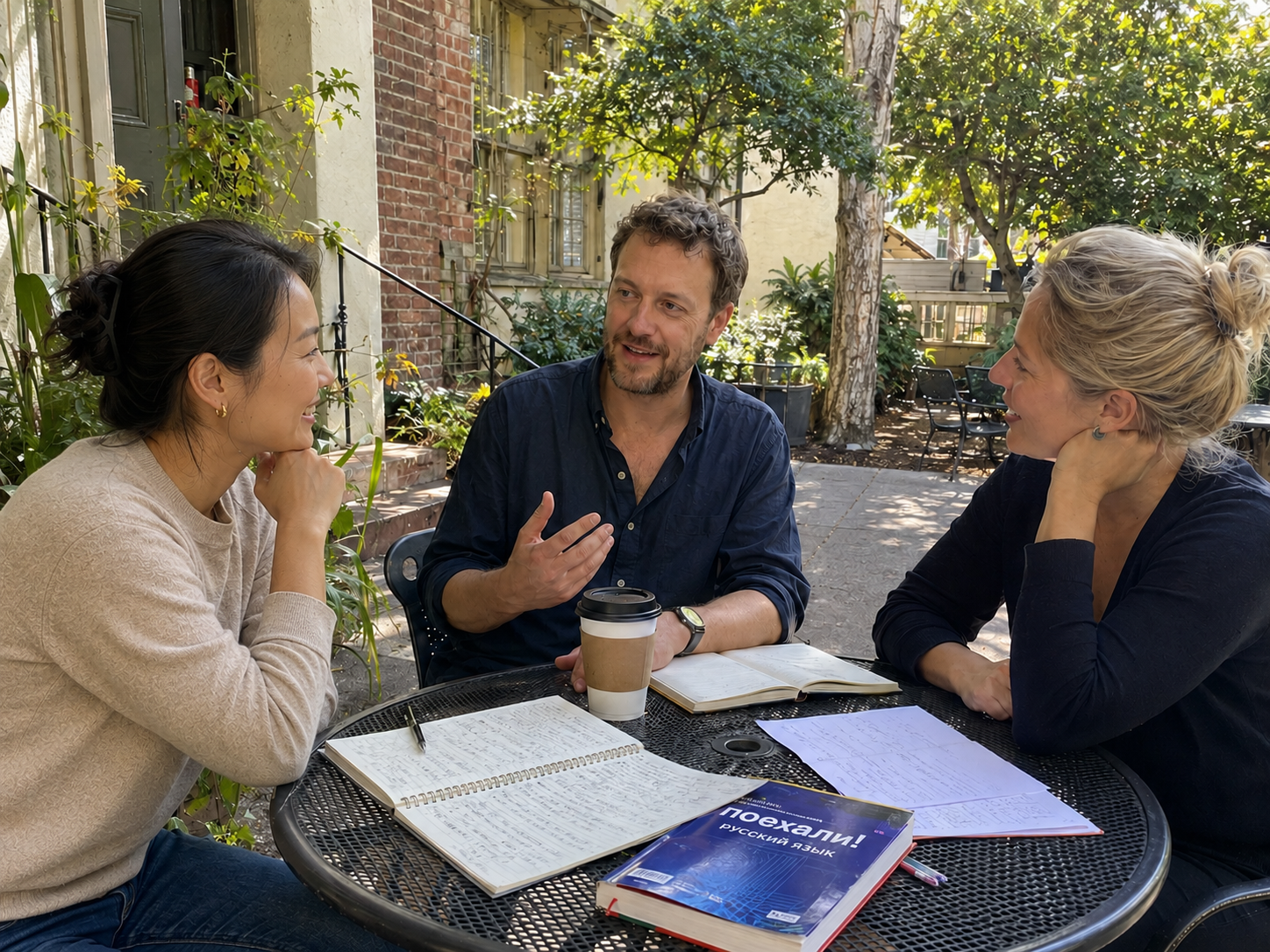
There is a moment many adult Russian learners know well. Someone asks a completely ordinary question:
Что ты делал на выходных?
Chto ty delal na vykhodnykh?
“What did you do over the weekend?”
You understand every word. You know how the past tense works. You have the vocabulary to talk about Saturday, Sunday, restaurants, friends, movies, work, travel, or whatever else you actually did.
And yet your answer does not come out.
Instead, you begin assembling it. You search for the right verb, remember that the ending depends on gender, wonder whether you need a preposition, think about the case that follows it, and realize that the other person is still waiting.
If the same question appeared in a workbook, you might answer it easily. Conversation is different because everything has to happen at once: listening, deciding what you want to say, retrieving vocabulary, choosing grammatical forms, pronouncing them, and then listening again when the other person responds.
This gap between knowing Russian and being able to use it spontaneously is one of the main reasons adults begin looking for Russian conversation classes. Often, they do not need another explanation of how the past tense works. They need more experience actually using the Russian they already know.
Why Speaking Feels So Much Harder
Written exercises give you time. You can reread the question, think about an ending, change your mind, or look back at a grammar rule.
Conversation does not give you quite the same luxury.
Suppose you want to say:
В прошлом году я была в Москве.
V proshlom godu ya byla v Moskve.
“I was in Moscow last year.”
For a female speaker, you need была rather than был. Москва becomes Москве because you are talking about being in Moscow. You also need to retrieve в прошлом году, “last year,” and put the sentence together while still following the conversation.
None of these elements is particularly difficult once you have studied them. What is difficult is accessing all of them quickly enough.
Russian instructors often see students who understand a grammatical pattern very well but still need several seconds to use it in spontaneous speech. Another student may read comfortably but struggle to follow a relatively simple spoken exchange. Someone else may know hundreds of words passively but keep reaching for the same small group of familiar words when speaking.
Speaking, listening, reading, and grammatical knowledge do not necessarily develop at the same pace, which is why a student's level on paper does not always tell you how comfortably that person can participate in a conversation.
What Conversation Practice Should Actually Do
A good Russian conversation class is not simply an hour in which several people are told to “talk in Russian.”
Unstructured conversation can be enjoyable, but it often has predictable weaknesses. The most confident speaker talks more. Quieter students wait. People stay with topics they already know how to discuss. If communication becomes difficult, the group may switch to English.
Structured conversation practice creates situations in which learners have to use Russian in ways that are slightly less predictable. You might tell a short story, describe something that happened during the week, react to another student's opinion, explain why you prefer one option to another, ask a follow-up question, or find another way to express an idea when you do not know the exact word.
That last skill becomes important very quickly. Real conversations do not stop every time someone lacks a piece of vocabulary.
Expressions such as these are simple but remarkably useful:
Не знаю, как сказать по-русски…
Ne znayu, kak skazat' po-russki…
“I don't know how to say it in Russian…”
Что ты имеешь в виду?
Chto ty imeyesh' v vidu?
“What do you mean?”
А ты?
A ty?
“And you?”
Правда?
Pravda?
“Really?”
Понятно.
Ponyatno.
“I see.” / “Got it.”
They help you react, clarify, keep another person talking, and give yourself a little time to organize what you want to say. Those skills rarely look impressive on a vocabulary list, but they are part of what makes a real conversation possible.
Learning How to Think While You Speak
Fluency is not the same thing as producing perfect sentences immediately.
Even native speakers hesitate, change direction, repeat themselves, search for a word, and reformulate what they were trying to say. Learners need some of the same conversational tools.
Russian expressions such as:
Я думаю, что…
Ya dumayu, chto…
“I think that…”
and:
Мне кажется, что…
Mne kazhetsya, chto…
“It seems to me that…” / “I think…”
give you a natural way to begin an idea while your brain is still organizing the rest of it.
This matters more once conversation moves beyond predictable beginner topics. Saying where you live is one thing. Explaining why you liked a film, what surprised you during a trip, why you disagree with someone, or how your job has changed requires much more linguistic flexibility.
At first, forming those thoughts can feel painfully slow. After you have used the same structures in many different conversations, some of the language begins to arrive without quite so much searching, leaving more attention for the idea itself.
Grammar Still Matters
There is a popular idea that learners should stop worrying about grammar and “just speak.” That advice is not especially useful for Russian.
Russian grammar carries a great deal of meaning. Cases show relationships between words. Verb endings identify subjects. Gender appears in past-tense forms. Aspect affects how actions are understood. Motion verbs express distinctions English often handles more generally.
The answer is not to forget grammar but to use it often enough that common patterns become easier to retrieve.
Consider:
Я интересуюсь русской культурой.
Ya interesuyus' russkoy kul'turoy.
“I am interested in Russian culture.”
When students first learn интересоваться, “to be interested in,” they may consciously remember that it takes the instrumental case. They work out that русская культура must become русской культурой.
The first few times they use the expression in conversation, that calculation may still happen consciously. After enough repetition, я интересуюсь… begins to feel naturally connected with the form that follows it. The grammatical knowledge is still there; it simply takes less effort to use.
Correction Without Stopping the Conversation
Adults learning Russian often know enough grammar to hear their own mistakes, which can sometimes make speaking harder rather than easier.
A learner begins a sentence, notices a wrong ending, stops, corrects it, becomes uncertain about the next word, starts again, and eventually forgets what they were trying to explain.
Correction is important. Repeated case errors, problems with verb forms, or mistakes that change the meaning should not simply be ignored. At the same time, interrupting every sentence can make genuine conversation nearly impossible.
In a productive class, some errors can be corrected immediately while others are better discussed after the student finishes the thought. A learner needs opportunities to speak for more than one sentence at a time, particularly at intermediate levels.
The point is not to choose between accuracy and fluency. Students need both, but they do not always have to work on both in exactly the same second.
Listening Is Part of Speaking
Students who say they want to improve their speaking sometimes overlook how much conversation depends on listening.
You may prepare a perfectly good answer to a question, but if the person asking it changes the wording or follows up with something unexpected, the conversation suddenly becomes much harder.
Natural Russian can feel fast even when the speaker is not deliberately speaking quickly. Unstressed vowels may sound different from what a learner expects from the spelling, familiar words blend into surrounding speech, and common conversational expressions appear that may not have received much attention in a textbook.
Regular conversation practice exposes you to this unpredictability in a manageable setting. You hear the same basic idea expressed in several ways. One person uses a word you know; someone else chooses another. An instructor asks a follow-up question you did not prepare for.
Over time, you stop waiting to hear one exact sentence pattern and become better at following the meaning even when the wording changes.
The Intermediate Plateau
Many learners feel most frustrated somewhere around the high beginner or lower intermediate stage.
By then, they know a fair amount. They have learned major case patterns, can form different tenses, have accumulated vocabulary, and may read reasonably well. Yet speaking can still feel slow and awkward.
At this stage, the problem is sometimes less about learning new Russian than about retrieving familiar Russian.
A word such as:
путешествие
puteshestviye
“trip” / “journey”
may be instantly recognizable on a page but surprisingly difficult to produce when someone suddenly asks where you would like to travel next.
This is why another hundred flashcards may not transform speaking as much as expected. Some of the vocabulary is already there; it simply has not been used often enough under conversational pressure.
When the same words and structures keep coming up in discussions, they become easier to reach. Sometimes a learner is surprised to discover that a word they thought they had forgotten was available all along once there was a reason to use it.
What Does “Gain Fluency Fast” Really Mean?
Fluency is not a single finish line.
Someone may speak comfortably about work and family but struggle with politics. Another learner may talk readily but continue making grammatical mistakes. A third may have excellent pronunciation and listening comprehension but lack the vocabulary to discuss unfamiliar subjects.
For people who have already built a foundation in Russian but rarely speak it, regular conversation practice can make certain changes appear fairly quickly. Familiar words become easier to retrieve. Common sentence patterns require less planning. Unexpected questions feel less destabilizing, and learners become better at finding another way to express an idea when the exact word is missing.
That does not mean someone becomes fluent after a short conversation course. Russian still takes time, and broader fluency requires vocabulary, grammar, listening, reading, and plenty of exposure. What conversation practice can do is prevent speaking from remaining the one skill that is continually postponed while everything else advances.
Conversation at Different Levels
Complete beginners can certainly speak Russian, but conversation at that stage needs structure. Learners may introduce themselves, talk about where they live, describe family members, discuss likes and dislikes, or practice simple questions about daily routines.
There is little value in asking a complete beginner to discuss an abstract topic they do not yet have the language to handle.
At the high beginner and lower intermediate levels, conversation becomes much more flexible. Students can talk about their week, describe experiences, make plans, compare places, tell short stories, and begin explaining why they think or prefer something.
This is often where conversation-focused classes become especially useful because learners have enough material to work with, but much of it is still slow to retrieve.
Intermediate and more advanced students can discuss longer and less predictable topics while working on precision, vocabulary range, natural phrasing, and listening speed.
The labels themselves tell only part of the story. Two students who have both completed an intermediate textbook may have very different speaking abilities. One may talk freely but make many grammatical mistakes; another may produce careful, accurate Russian only after long pauses.
Heritage Learners Often Have a Different Profile
Heritage Russian learners can be particularly difficult to place because their skills are often uneven.
Someone who grew up hearing Russian from parents or grandparents may understand family conversation easily and have very natural pronunciation, yet struggle to read or explain grammatical rules. Another person may speak comfortably about food, family, and childhood but lack vocabulary for work, education, politics, or more abstract subjects.
A Russian family background therefore does not automatically mean someone belongs in an advanced conversation class.
For heritage learners, conversation classes can help broaden Russian beyond the situations in which it was originally acquired. They may also become more aware of patterns they have always used intuitively without knowing why, while filling vocabulary gaps that did not matter when most of their Russian was used at home.
Conversation Classes in Berkeley and Online
For adults in Berkeley, Oakland, and other parts of the East Bay, an in-person Russian class can be appealing simply because speaking face-to-face feels different from studying alone. Russian stops being something associated mainly with an app, textbook, or screen and becomes something you use with other people at a regular time each week.
Polyglottist Language Academy offers Russian classes for adults in Berkeley, with levels and formats changing according to the current term. Some students prefer being in the room with their classmates, while others choose online instruction because they live farther away, have a long commute, or find that the schedule fits their lives better.
Online conversation practice can still work very well when the group gives everyone enough time to participate. For speaking development, the important question is less whether everyone is physically in the same room and more whether students are actually talking, listening, reacting to one another, and receiving useful guidance.
For many adults, the best format is simply the one they can attend consistently.
Conversation Class or Russian Meetup?
An informal Russian meetup and an instructor-led class can both be useful, but the experience is different.
At a meetup, conversation develops naturally. That can be excellent practice for students who already feel reasonably comfortable speaking, and it gives learners a chance to use Russian socially rather than as a classroom subject.
It can also be unpredictable. Participants may have very different levels, conversations may switch to English, and stronger speakers naturally tend to talk more. No one is necessarily paying attention to a grammatical problem that keeps appearing.
In a class, the discussion can be structured around the level of the students. An instructor can introduce useful language before a topic, make sure quieter students participate, notice recurring errors, and return to a grammatical pattern that needs more practice.
There is no need to choose one permanently over the other. A learner might use a class for regular structure and feedback, then take advantage of informal opportunities when they want more spontaneous social practice.
What to Do Between Classes
One of the most useful things you can do after a conversation class is remember what you wanted to say but could not.
Those gaps reveal the vocabulary that is actually relevant to your life.
If you tried to describe a trip and lacked basic transportation words, review them. If you repeatedly became confused when talking about past events, revisit those forms. If someone used a phrase that seemed particularly natural, write it down and try to use it the following week.
You can also record yourself speaking for a minute or two about your day without preparing a script. Listening back often reveals patterns you do not notice while speaking: long pauses, vocabulary you rely on too heavily, unfinished sentences, or grammatical constructions you consistently avoid.
Preparing some vocabulary for a topic is useful. Preparing every sentence is not. If you already know exactly what you are going to say, you are practicing a presentation rather than conversation.
Finding the Right Russian Class
The most useful conversation class is generally one that matches what you can actually do with Russian rather than simply how many years you have studied.
A learner who has taken several courses but rarely spoken may need more support than expected. A heritage speaker might require more advanced conversational work while still needing help with grammar. Someone who reads very well may discover that their listening level is considerably lower.
For adults who want more structured speaking practice, Polyglottist Language Academy offers Russian classes for adults in Berkeley and online, with conversation-focused opportunities depending on the current level and schedule.
The progress learners notice is usually less dramatic than the word “fluency” suggests, but also more useful. Someone asks what you did over the weekend, and you begin answering before you have mentally constructed the entire sentence. You may still pause, choose the wrong ending and correct yourself, or discover that one word refuses to appear when you need it.
What has changed is that the conversation itself is now happening in Russian. You are no longer solving the language first and speaking only after you have found the perfect answer.