
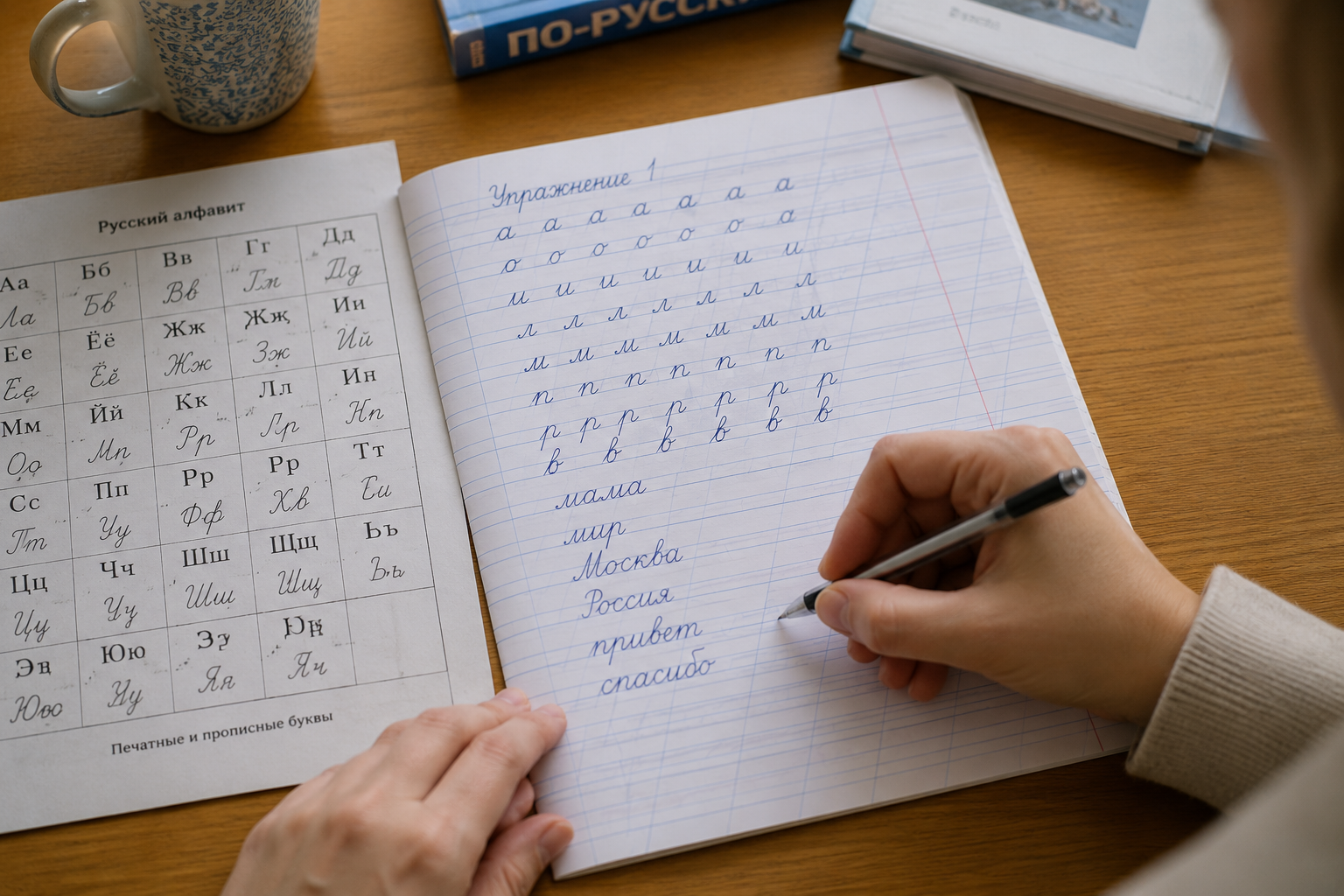
You have learned the Cyrillic alphabet. You can read Москва, recognize спасибо, and perhaps even sound out a Russian menu without reaching for your phone.
Then someone writes a short note by hand.
Suddenly, т looks like an English m, д resembles a g, п has turned into an n, and an innocent word such as машинаappears to be made from a continuous row of humps. It can feel as though Russian speakers have quietly replaced the alphabet you studied with another one.
They have not.
Russian print and Russian cursive are two visual forms of the same alphabet. The sounds, spelling rules, and words remain unchanged. What changes is the way the letters are shaped and connected—and, just as importantly, the way the reader learns to see them.
For adult students, Russian cursive is best understood not as a second alphabet to memorize, but as the more personal face of written Russian. Print belongs to books, screens, street signs, and newspapers. Handwriting appears in notebooks, recipes, postcards, classroom comments, family letters, forms, signatures, and the margins of old manuscripts.
Learning to read it means gaining access to the Russian language when it leaves the keyboard and enters everyday life.
One Alphabet with Four Different Faces
English speakers are already familiar with the idea that one letter can have several forms. A printed lowercase a may look quite different from the a we write by hand. An elaborate signature may barely resemble the letters in the signer’s name.
Russian simply takes this visual flexibility further.
A learner may encounter four main forms of Cyrillic:
Printed Cyrillic appears in books, websites, apps, signs, and most typed documents. These are the upright forms learners usually meet first.
Handwritten block letters imitate printed shapes but are written separately. Foreign learners often use them at first because they feel safer and more recognizable.
Italic Cyrillic appears in books, menus, headings, and passages requiring emphasis. Its lowercase letters often resemble cursive more than upright print.
Connected cursive is the traditional handwriting style taught in Russian schools. Letters are simplified, slanted, and joined so that words can be written efficiently.
In Russian, printed letters are commonly called печатные буквы. Handwritten forms may be called письменные буквы, while a handwritten text is рукописный текст.
This distinction matters because a student who knows only upright printed Cyrillic may still be surprised by an italic restaurant menu, a teacher’s comments, or a handwritten greeting card. Recognizing the alphabet’s different “faces” makes all of these situations considerably easier.
Why Do the Letters Change So Much?
Russian cursive did not develop to confuse language learners. It developed because people needed to write quickly.
Earlier forms of rapid Cyrillic handwriting were used for administration and correspondence long before modern school notebooks existed. During the eighteenth century, Russian printed type was reshaped and simplified under Peter the Great. Handwriting evolved alongside the new civil script, while italic typography borrowed several forms from handwritten letters.
Over time, handwriting became standardized through school instruction. Children practised the same basic strokes, connections, proportions, and rightward slant. The goal was not decorative calligraphy. It was a practical combination of speed and legibility.
That history explains why a printed letter and its cursive equivalent do not always look closely related. A cursive shape is often the result of the movement required to produce it smoothly, rather than an attempt to reproduce the printed form exactly.
You can think of Russian cursive as an old productivity system: a script designed for ink, paper, and continuous movement rather than keyboards and touchscreens.
The Letters That Play Tricks on English-Speaking Eyes
Some Cyrillic letters remain relatively recognizable in handwriting. Others appear to change identity completely.
The greatest difficulty for English speakers is not simply that the shapes are unfamiliar. It is that several cursive letters resemble Latin letters—but represent completely different Russian sounds.
Here are some of the most important transformations:
Printed letterCommon cursive resemblanceRussian soundдa handwritten Latin gdтa small Latin mtпa Latin npиa Latin uee as in seeшa Latin wshрa Latin prolled or tapped rгsometimes similar to a cursive rhard g
These are visual false friends. Your eyes recognize a familiar shape, but your brain assigns it the wrong sound.
Take the word там, meaning “there.” In traditional cursive, the т may resemble an English m. A beginner can look directly at the word and still fail to recognize it because the Latin alphabet is interfering.
The same problem appears in:
папа — papa, “dad”
дом — dom, “house”
год — god, “year”
игра — igra, “game”
школа — shkola, “school”
вода — voda, “water”
When you read these words in cursive, do not ask, “Which English letter does this resemble?” Ask, “Which Russian cursive shape is this?”
That small change in thinking is one of the most important steps toward fluent recognition.
The Famous Russian Cursive “Humps”
Russian handwriting has become something of an internet spectacle because certain words appear to contain long rows of nearly identical strokes.
Letters such as и, л, м, п, т, ш, щ and sometimes ы are formed from related upward and downward movements. When several occur together, it can become difficult to see where one letter ends and the next begins.
The word машина—“car”—is a useful example. Its central sequence contains м, ш, и, and н, creating repeated curves and humps.
An even more notorious example is:
лишишь
lishish
“you will deprive”
Written quickly, much of the word can resemble one continuous wave.
This looks alarming when isolated as a handwriting puzzle. Real reading, however, does not normally happen in isolation. Russian speakers use several kinds of information at once:
the first and final letters;
the expected length of the word;
familiar prefixes, roots, and endings;
the grammar of the sentence;
the subject being discussed;
the writer’s individual habits.
English readers do the same thing. We can often understand hurried handwriting even when individual letters are unclear because we recognize the likely word and sentence.
A native Russian speaker does not necessarily count every hump in машина. The whole visual pattern becomes familiar. Adult learners gradually develop the same ability.
Italics Are the Missing Bridge
Many students believe they are encountering cursive for the first time when they see handwriting. In reality, they may already have met several cursive shapes in italic Cyrillic.
Russian italic type is more than upright print tilted to the side. Several lowercase letters change form:
italic т may resemble a Latin m;
italic п may resemble n;
italic д may resemble a looped handwritten form;
л, м, ш, and щ may look much closer to handwriting than to upright print.
This is why a restaurant menu, book title, or literary quotation can unexpectedly become difficult even when it is typed.
Rather than treating italics as another obstacle, use them as training. Every time you encounter slanted Cyrillic, pause and identify the unfamiliar forms. Italics provide a controlled bridge between clean printed text and unpredictable personal handwriting.
For app-trained learners in particular, this can be a revelation. An app may present only one standardized font, giving the impression that Cyrillic letters always look the same. Real language is visually more flexible.
Do You Actually Need to Learn Russian Cursive?
That depends on what you want to do with Russian.
For a short trip, you can function largely through printed text. Airport signs, transportation maps, websites, restaurant listings, and digital messages generally use printed Cyrillic. You do not need beautiful handwriting to order coffee or find your train.
Cursive becomes more useful when you want to:
take a course in which the instructor writes by hand;
complete written exercises or examinations;
read corrections in a notebook;
fill out forms;
understand personal notes and greeting cards;
write naturally and efficiently;
study family documents or archival materials;
read literary manuscripts and historical correspondence.
There is also an important difference between reading cursive and producing perfect cursive.
For most adults, recognition should come first. Being able to decipher common handwritten forms is often more useful than reproducing every traditional connection flawlessly. You can develop a legible personal style later.
You do not need the elegant, uniform handwriting of a first-grade model book. You need to form letters consistently enough that another person can read them.
How Russian Children Learn: The World of Прописи
Russian children traditionally learn handwriting through workbooks called прописи.
A page of прописи does not usually begin with a complete letter. It may begin with a row of hooks, loops, slanted lines, ovals, or humps. Children trace and repeat these elements because the same pen movements reappear in many letters.
They then practise:
consistent rightward slant;
letter height and proportion;
spacing between letters and words;
entry and exit strokes;
connections between different letter combinations;
short words and eventually full sentences.
This method can look repetitive, but it reflects an important truth: cursive is a physical skill. Knowing intellectually what a letter should look like is not the same as producing it comfortably.
Adults can use прописи too, but they do not need to complete hundreds of pages. A targeted approach works well: identify the movements that feel unfamiliar, practise the most confusing letters, and then move quickly into meaningful words.
A Better Practice Method for Busy Adults
Trying to memorize all cursive forms in one sitting usually creates frustration. A more effective method is to learn letters in families according to the movements they share.
Begin with familiar loops
Start with letters whose handwritten forms remain relatively intuitive, such as:
а, о, е, с
Practise short words instead of isolated rows for too long:
мама — mama, “mum”
она — ona, “she”
сам — sam, “oneself” or “himself”
Then tackle the hump family
Group together:
и, й, л, м, п, т, ш, щ
These letters are difficult precisely because they share movements. Studying them together helps you notice their differences.
Useful words include:
мир — mir, “peace” or “world”
там — tam, “there”
папа — papa, “dad”
школа — shkola, “school”
машина — mashina, “car”
Add letters with tails and descenders
Next practise letters such as:
д, у, ц, р, ф
Try:
дом — dom, “house”
друг — drug, “friend”
улица — ulitsa, “street”
работа — rabota, “work”
Compare print and cursive every time
Write the printed word first and the cursive version beneath it. Say each letter or sound aloud as you write.
This creates a three-way connection between:
the printed form;
the handwritten form;
the sound and meaning.
Practise for ten minutes, not an hour
A realistic routine might look like this:
two minutes reviewing letter pairs;
three minutes tracing or copying;
three minutes writing familiar words from memory;
two minutes reading someone else’s handwriting.
Ten focused minutes a day is more effective than one exhausting practice session every few weeks.
Most importantly, practise slowly. Speed is the result of familiarity, not the starting point.
Textbook Cursive Is Not Real-Life Cursive
After working through neat handwriting models, learners often experience a second shock: actual adults do not write like handwriting workbooks.
Real Russian handwriting may include:
letters that are only partly connected;
printed and cursive forms used together;
simplified loops;
personal versions of д, т, or л;
abbreviations;
uneven slant;
compressed endings;
missing details that the writer assumes will be understood.
Some Russians write a traditional m-shaped т. Others use a printed-style т because it is clearer. The letter д also has accepted variations. One person’s л may be carefully pointed, while another’s blends into the surrounding strokes.
This does not mean that anything is acceptable. It means handwriting contains personal variation.
In Russian, почерк means a person’s handwriting or handwriting style. A teacher may praise разборчивый почерк—legible handwriting—or complain about неразборчивый почерк, handwriting that is difficult to decipher.
Native speakers are not magically able to read every handwritten note. Russians also struggle with rushed medical handwriting, unusual signatures, old documents, and particularly chaotic personal styles.
When beginning to read authentic handwriting, start with one consistent writer—perhaps your instructor—rather than collecting random samples from many people. Once you become familiar with one почерк, variation becomes less intimidating.
Common Mistakes That Make Cursive Harder Than It Needs to Be
Trusting Latin instincts
A shape that resembles m may be Russian т. A shape like n may be п. Always interpret it within the Cyrillic system.
Mixing forms without a pattern
Real Russians sometimes combine printed and cursive forms, but beginners often do so randomly because they cannot remember a letter. The result can be harder to read than either style alone.
Learn the standard forms first. Personal variation should come after control, not before it.
Copying decorative computer fonts
A beautiful script font may imitate calligraphy rather than ordinary handwriting. It can contain exaggerated loops and connections that few people use naturally.
Model your writing on educational handwriting samples or a trusted teacher’s writing.
Trying to connect absolutely everything
School models emphasize connections, but real writers frequently lift the pen. Clear, partially connected handwriting is better than a fully connected word that no one can read.
Writing too quickly
Learners sometimes assume that cursive must be fast. In the beginning, speed usually destroys proportion and makes similar letters indistinguishable.
Slow handwriting is not failed cursive. It is cursive under construction.
Small Russian Words That Help You Talk About Handwriting
These terms are useful in a classroom, stationery shop, archive, or conversation about writing:
буква — bukva — letter of the alphabet
алфавит — alfavit — alphabet
почерк — pocherk — handwriting style
прописи — propisi — handwriting practice workbooks
тетрадь — tetrad’ — notebook
ручка — ruchka — pen
карандаш — karandash — pencil
писать от руки — pisat’ ot ruki — to write by hand
печатные буквы — pechatnye bukvy — printed or block letters
письменные буквы — pis’mennye bukvy — handwritten letters
разборчиво — razborchivo — legibly
неразборчиво — nerazborchivo — illegibly
A teacher might say:
Пишите разборчиво, пожалуйста.
Pishite razborchivo, pozhaluysta.
“Please write legibly.”
Or ask:
Вы можете написать это от руки?
Vy mozhete napisat’ eto ot ruki?
“Can you write this by hand?”
These phrases turn handwriting practice into practical language rather than an isolated penmanship exercise.
What Handwriting Reveals About Russian Life
Cursive matters for more than classroom exercises.
A handwritten recipe may preserve the vocabulary of family meals. A postcard can reveal forms of affection that feel different from formal textbook language. A teacher’s marginal note shows how Russians abbreviate and communicate quickly. A wartime letter or an old diary offers direct access to an individual voice.
For students interested in literature, handwriting creates an especially intimate connection. A published poem appears finished and permanent. A manuscript page may contain crossed-out lines, substitutions, hesitation, and sudden inspiration. The physical page records thinking in motion.
That is one reason cursive remains culturally valuable even in a digital world. It opens a door not only to information, but to personality, memory, and private history.
Printed Russian tells you what was published. Handwritten Russian often shows what someone was thinking, correcting, remembering, or trying to say to one particular person.
You Do Not Need Beautiful Handwriting
Many adult learners worry that their cursive looks childish or obviously foreign. It probably will at first. That is normal.
Your goal is not to win a calligraphy competition or reproduce a Soviet-era school model perfectly. A functional standard is enough:
letters should be identifiable;
similar shapes should remain distinguishable;
spacing should make word boundaries clear;
your forms should be reasonably consistent;
another reader should not have to guess every word.
An imperfect but readable почерк is far more useful than elegant writing that takes five minutes per sentence.
At Polyglottist Language Academy, we often encourage students to treat handwriting as part of a larger relationship with Russian. Grammar and vocabulary matter, but so do the visual and cultural details surrounding the language: school notebooks, literary manuscripts, handwritten recipes, old postcards, personal messages, and everyday expressions.
Students who would like guided practice can explore our Russian classes online or in the Berkeley area. A teacher can help you distinguish standard forms from personal variations, correct confusing letter connections, and introduce handwritten materials at the right pace.
Questions Learners Often Ask
Is Russian cursive a different alphabet?
No. Printed and handwritten Russian use the same 33-letter Cyrillic alphabet. The letters may change shape, but their sounds and spelling functions remain the same.
Can I write Russian using only printed block letters?
Yes, and people will usually understand you if the letters are clear. However, block handwriting may look slow, childlike, or noticeably foreign. Learning at least basic cursive will make writing more natural and help you read other people’s notes.
Should I learn cursive at the same time as printed Cyrillic?
Complete beginners should first become comfortable recognizing printed letters and their sounds. Basic cursive forms can then be introduced fairly early. Trying to master both systems simultaneously may confuse some learners, while others enjoy seeing the connection from the beginning.
How can I tell letters apart when they all look like humps?
Look at the whole word rather than counting strokes in isolation. Use the first and last letters, familiar roots, grammatical endings, and sentence context. With practice, common words become recognizable as complete visual patterns.
Must every letter be connected?
No. Traditional school cursive connects most letters, but real adult handwriting often includes pen lifts and partial connections. Legibility is more important than maintaining one unbroken line.
How long does it take to become comfortable with Russian cursive?
Many learners can recognize the main forms and write simple words after two or three weeks of short daily practice. Reading varied personal handwriting takes longer because every writer develops individual habits.
Is cursive still used in Russia?
Yes. Digital communication dominates many areas of life, but cursive is still taught in school and used for classwork, examinations, notes, forms, signatures, cards, and personal writing. Its role has changed, but it has not disappeared.
The first handwritten Russian note you encounter may look like a wall of loops. A few weeks later, those loops begin to separate into letters. Then the letters become words, and the words reveal a voice.
That transformation is the real pleasure of learning cursive. You are not merely training your hand to imitate unfamiliar shapes. You are learning to recognize Russian when it becomes personal—when it is written quickly in a notebook, carefully inside a card, or preserved in ink on a page that someone once held.
Related Reading
Is Russian Hard To Learn? The Honest Answer (With Hours, Timelines, And Tips)
Why Learn Russian? 7 Surprisingly Good Reasons Americans Are Studying It In 2026
Russian Pronunciation For Beginners: The Sounds That Matter Most
The Russian Alphabet In 2 Hours: A Complete Beginner's Guide To Cyrillic
Why You Still Can’t Read Russian After Learning The Alphabet
The Fastest Way To Start Speaking Russian As An Absolute Beginner