
The Legacy of Spanish Explorers: How They Shaped the World
A map of the Americas is one of the easiest places to see the legacy of Spanish exploration. California, Nevada, Colorado, Florida, Los Angeles, San Francisco, Santa Fe, San Antonio, and El Paso all carry Spanish names. Cross the Pacific and the historical footprint continues in the Philippines, where Spanish surnames, Catholic traditions, architecture, vocabulary, and place names remain part of everyday life.
Those names are only the most visible layer of a much larger story.
From the late fifteenth century onward, voyages sponsored by the Spanish Crown helped connect Europe, the Americas, Africa, and Asia on a scale that had not existed before. Ships carried silver from Mexico and the Andes across the Atlantic and Pacific. American crops such as tomatoes, potatoes, maize, cacao, and chili peppers transformed cuisines far from their places of origin. Horses, wheat, cattle, and sugar moved in the opposite direction. Spanish became one of the world's major languages.
The consequences were enormous, but this was never simply a story of daring sailors opening up the world. Exploration was closely tied to conquest, colonization, missionary activity, forced labor, warfare, and catastrophic population loss among Indigenous societies. Even the familiar word “discovery” becomes problematic when applied to lands already inhabited by millions of people.
The legacy of Spanish explorers is therefore less useful as a heroic story than as the beginning of a profound reorganization of the world. Their voyages helped create new trade routes, new empires, new cultural mixtures, and new forms of inequality. Much of what followed still shapes the languages people speak, the food they eat, the cities they live in, and the histories they inherit.
1492 Opened a New Atlantic World
The voyage most often associated with the beginning of Spanish overseas expansion was not actually led by a Spaniard.
Christopher Columbus, or Cristóbal Colón in Spanish, was born in Genoa. After unsuccessfully seeking support elsewhere, he persuaded Isabella I of Castile and Ferdinand II of Aragon to finance a westward voyage in search of Asia. When his expedition reached the Caribbean in October 1492, Columbus believed he had arrived near Asia rather than on lands previously unknown to Europeans.
For Europeans, the voyage fundamentally altered geographic understanding. For the Taíno and other Indigenous peoples of the Caribbean, it marked the beginning of a period of colonization that would transform their societies with devastating speed.
Within a few decades, Spanish expeditions had reached the mainland of the Americas, crossed Mexico, entered the Andes, traveled through parts of what is now the United States, and reached the Pacific. The Atlantic was no longer simply a vast barrier separating continents. It became a heavily traveled route carrying people, goods, animals, plants, money, ideas, and disease in both directions.
Historians often use the term Columbian Exchange to describe the enormous biological and cultural movement that followed. Europeans introduced horses, cattle, pigs, sheep, wheat, sugarcane, and other plants and animals to the Americas. From the Americas came potatoes, tomatoes, maize, cacao, squash, peppers, and many varieties of beans.
The effects eventually became so familiar that their origins are easy to forget. Italian cooking without tomatoes, central European cooking without potatoes, Hungarian cuisine without paprika, or Swiss chocolate would all look very different without crops that originated in the Americas.
Disease traveled alongside food, animals, and people. Smallpox and other infections brought from Europe devastated Indigenous communities with no previous exposure to them. Epidemics interacted with warfare, displacement, enslavement, and forced labor, contributing to one of the most severe demographic collapses in recorded history.
The same voyages that expanded European geographic knowledge therefore also initiated a human catastrophe on an enormous scale.
Conquest Depended on More Than Spanish Weapons
Hernán Cortés and Francisco Pizarro are often listed alongside Spanish explorers, although “conquistador” describes their roles more accurately.
Cortés arrived on the Mexican mainland in 1519 and moved toward Tenochtitlan, the capital of the Aztec Empire. Older popular histories sometimes presented the conquest as an almost improbable victory by a small group of Spaniards using superior weapons against a vast empire.
That version leaves out much of what actually made the conquest possible.
Cortés relied heavily on Indigenous allies who had their own political reasons for opposing Aztec power. Tlaxcalans and other Indigenous groups fought alongside the Spaniards in large numbers. Local rivalries, shifting alliances, epidemic disease, military strategy, and the siege of Tenochtitlan all mattered.
Communication was equally important. Malintzin, also known as Malinche or Doña Marina, served as interpreter and intermediary for Cortés. Her linguistic knowledge and ability to move between cultural and political worlds made her central to the negotiations and alliances surrounding the conquest.
Tenochtitlan fell in 1521. Mexico City then developed over the remains of the Aztec capital, creating a physical and cultural landscape in which colonial Spanish buildings, Indigenous communities, older sacred sites, and new institutions became entangled.
The same complexity appears in the conquest of the Inca Empire.
Francisco Pizarro entered the Andes in the early 1530s at a moment when the empire had recently been weakened by civil war. Epidemic disease had also spread ahead of direct Spanish expansion in some areas. In 1532, Pizarro's forces captured the Inca ruler Atahualpa at Cajamarca. Although an enormous ransom was assembled in gold and silver, Atahualpa was later executed.
Spanish forces eventually occupied Cusco, but the conquest was not immediate or complete. Indigenous resistance continued for decades, and colonial rule developed through prolonged conflict, negotiation, forced labor, and adaptation.
The wealth extracted from the Andes would soon affect regions far beyond South America.
Silver from mines such as Potosí, in present-day Bolivia, entered the Spanish imperial economy in huge quantities. Indigenous laborers worked under brutal conditions, while the metal moved through trade networks reaching Europe and, increasingly, Asia.
Spanish American silver became especially important in commerce with China, where demand for silver was high. In this sense, events in the Andes were already connected to markets on the other side of the world.
A Voyage Around the World Revealed How Large the Planet Really Was
The expedition that demonstrated this global connection most dramatically began in 1519 under Ferdinand Magellan, or Fernando de Magallanes, a Portuguese navigator sailing for the Spanish Crown.
Five ships left Spain in search of a western route to the spice-producing islands of Southeast Asia. After crossing the Atlantic, the expedition eventually found a passage through the southern tip of South America, now known as the Strait of Magellan.
Beyond it lay an ocean that seemed calm after the difficult passage, leading Magellan to call it the Mar Pacífico, the “peaceful sea.”
The name did not capture what the crossing was actually like. The Pacific proved vastly larger than the expedition had expected. Food became scarce, sailors suffered from malnutrition and disease, and months passed before the ships reached inhabited islands where they could resupply.
Magellan eventually arrived in the Philippines, where he became involved in local political conflicts and was killed at the Battle of Mactan in 1521. The expedition continued without him under other commanders, eventually coming under the leadership of the Basque navigator Juan Sebastián Elcano.
When the ship Victoria returned to Spain in 1522, only a small fraction of the original expedition had completed the entire circumnavigation.
The voyage changed European geographic understanding. It demonstrated not only that the world's oceans were connected, but also how enormous the Pacific actually was. It opened practical questions about long-distance navigation that Spain would continue trying to solve for decades.
Those efforts eventually helped create a regular route between the Americas and Asia.
Manila and Acapulco Became Part of the Same Trade System
Spain established a permanent colonial presence in the Philippines during the sixteenth century. Miguel López de Legazpi played a major role in establishing Spanish rule, while the friar and navigator Andrés de Urdaneta helped solve one of the most difficult navigational problems in the Pacific: how to sail successfully from Asia back toward the Americas.
The prevailing winds and currents made a direct eastward crossing difficult. Urdaneta's successful route traveled north before turning east across the Pacific toward the coast of North America.
That route made possible the Manila-Acapulco galleon trade, which lasted for roughly two and a half centuries.
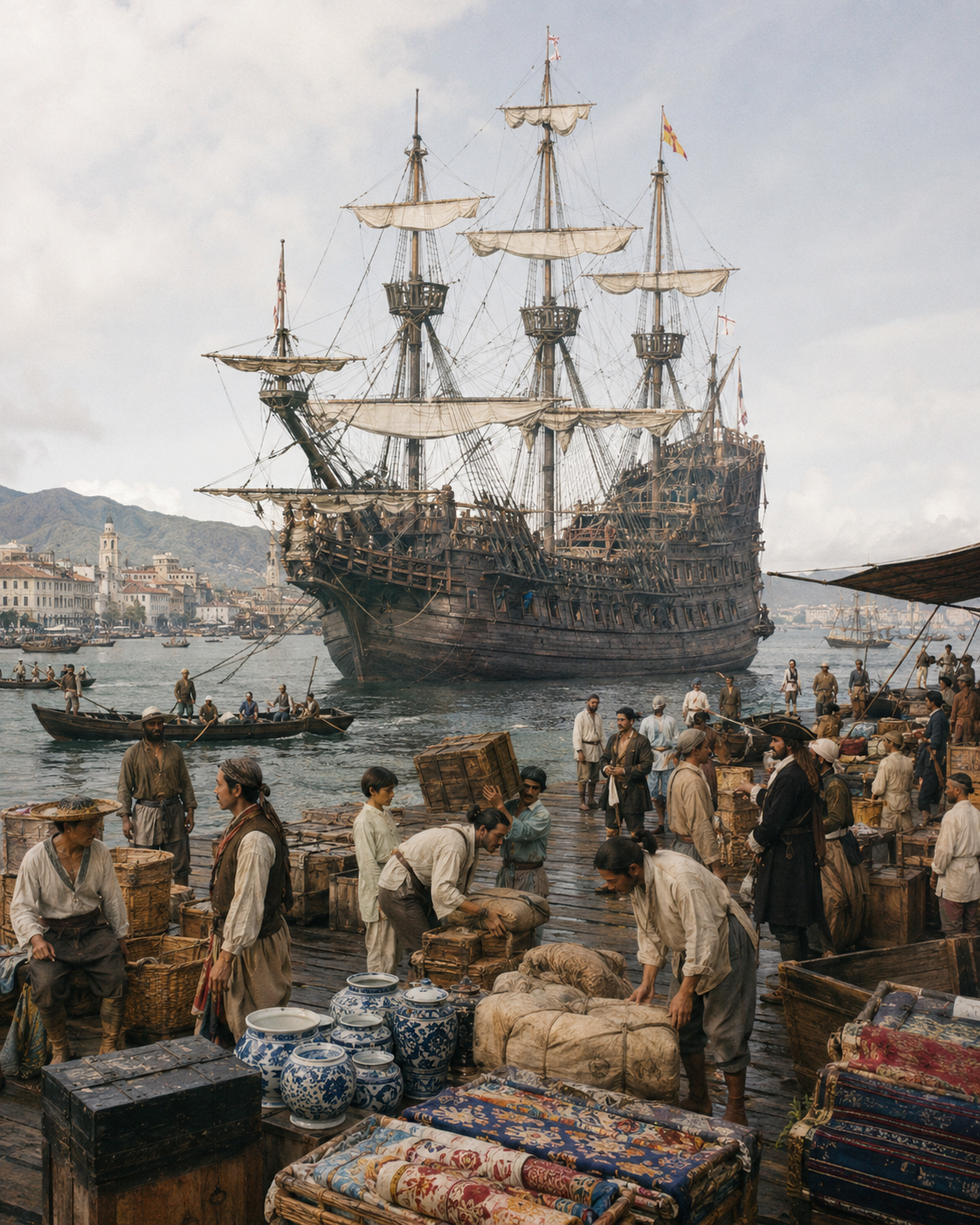
Spanish American silver traveled west across the Pacific, while Asian silk, porcelain, spices, and luxury goods traveled east. Some of those goods then crossed Mexico before continuing toward Europe.
The distances involved are remarkable. A merchant in Manila could become economically connected to silver mines in Mexico or the Andes, merchants in China, officials in Spain, and consumers elsewhere in Europe.
The cultural consequences of Spanish rule in the Philippines were equally lasting. Catholicism became deeply rooted, Spanish surnames became common, and Spanish vocabulary entered Filipino languages. Architecture, festivals, religious traditions, and food also absorbed Spanish influences, even though Spanish itself is no longer the everyday language of most Filipinos.
This Pacific connection makes the history of Spanish exploration much larger than a simple Europe-and-Americas story.
Spanish Expeditions Left Their Mark Across North America
Spanish exploration also extended deep into regions that later became part of the United States.
Juan Ponce de León reached Florida in the early sixteenth century. Álvar Núñez Cabeza de Vaca spent years traveling through parts of what are now Texas, northern Mexico, and the American Southwest after a disastrous expedition left him stranded. Hernando de Soto moved through large areas of the Southeast, while Francisco Vázquez de Coronado traveled through the Southwest searching for the wealthy cities Europeans imagined might exist there.
Many of these expeditions failed to find the riches their leaders expected, but the geographic information they gathered influenced later Spanish expansion.
Settlements, missions, ranches, forts, and towns eventually appeared across Florida, Texas, New Mexico, Arizona, and California. Long after political control shifted, the Spanish language remained embedded in the landscape.
San Francisco means Saint Francis. Santa Fe means holy faith. Nevada refers to something snow-covered, while Colorado comes from a word associated with reddish coloring. Los Angeles and San Antonio preserve the names of saints and religious traditions carried into colonial naming practices.
The linguistic traces are so ordinary today that it is easy to overlook how much history is contained in them.
These Expeditions Never Crossed Empty Lands
Maps of exploration often reduce entire journeys to arrows moving across continents. The visual simplicity can create the impression that Europeans crossed mostly empty territory until they reached some destination worth recording.
In reality, Spanish expeditions entered landscapes occupied by complex societies with their own languages, governments, trade networks, religious traditions, agricultural systems, and political rivalries.
European travelers often depended on Indigenous communities for food, guides, translators, geographical knowledge, and alliances. At other moments, those same communities resisted them or attempted to force them out.
Cabeza de Vaca's experience illustrates how dependent Europeans could become on the societies they encountered. After the collapse of the Narváez expedition in Florida, he spent years living and traveling among Indigenous communities before eventually reaching Spanish-controlled territory in Mexico. His later written account contains some of the earliest European descriptions of Indigenous peoples in parts of what became the southern United States.
Once exploration is viewed from this perspective, the story changes. European navigators may have recorded routes on maps, but they were moving through worlds already known intimately by the people who lived there.
Spanish Became Global, but It Changed Along the Way
One of the most visible legacies of Spanish imperial expansion is the language itself.
Spanish is now spoken across most of Latin America, throughout Spain, and by large communities elsewhere, especially in the United States. Yet the language did not simply leave Spain in the sixteenth century and remain unchanged.
It absorbed vocabulary from the societies Spanish speakers encountered.
Tomate entered Spanish from Nahuatl. Canoa came from a Caribbean Indigenous language. Chocolate also has Indigenous Mesoamerican origins. Numerous words connected with foods, plants, animals, geography, and local objects entered Spanish because Europeans encountered things for which they had no existing terms.
Influence moved in the other direction as well. Indigenous languages across Latin America absorbed Spanish vocabulary, while Spanish increasingly became the language of administration, religion, education, and commerce in many colonial societies.
This helps explain why Spanish-speaking cultures cannot be treated as variations of Spain transplanted overseas. Mexican Spanish developed within a very different linguistic and cultural environment from Argentine, Caribbean, Andean, or Iberian Spanish.
The language may be shared, but its history is profoundly regional.
Some of the Most Lasting Changes Happened in the Kitchen
The movement of foods after 1492 may be one of the clearest examples of how exploration reshaped everyday life.
Before sustained contact with the Americas, Europeans had no tomatoes, potatoes, maize, cacao, or chili peppers. Those crops eventually traveled far beyond Spain and became central to cuisines in places that had no previous connection with the Americas.
The tomato became fundamental to Italian cooking. Potatoes became a staple across much of northern and eastern Europe. Chili peppers traveled through global trade networks and eventually became essential to cuisines across South and East Asia. Cacao became the basis of a global chocolate industry.
The movement in the opposite direction was just as significant. Europeans introduced wheat, cattle, pigs, sheep, grapes, horses, and sugarcane into the Americas.
Horses transformed mobility, hunting, warfare, and trade among some Indigenous societies, particularly in parts of North America.
Sugar had a much darker impact. Expanding plantation economies created enormous demand for labor and became closely linked to the transatlantic slave trade. Millions of Africans were forcibly transported to the Americas, where their labor became fundamental to colonial economies and where African cultures profoundly shaped the societies that emerged.
The foods exchanged across the Atlantic therefore tell a larger story about migration, empire, labor, and power.
A More Connected World Was Also a More Unequal One
By the late sixteenth century, the world was connected in ways that would have been difficult to imagine only a century earlier. Silver mined in the Americas could end up in China. Asian silk might reach Mexico and then Europe. American cacao crossed the Atlantic. Missionaries traveled across oceans. People from Europe, Africa, the Americas, and Asia increasingly became part of the same economic systems.
Those connections were not created on equal terms.
Spanish colonial expansion transferred land and resources, imposed new political systems, and subjected many Indigenous communities to forced labor, displacement, and religious pressure. The transatlantic slave trade forcibly incorporated millions of Africans into the colonial world.
At the same time, colonial societies produced new communities and identities. Europeans, Indigenous peoples, Africans, and later migrants from Asia lived together in circumstances ranging from coercion to cooperation and intermarriage. New foods, languages, musical traditions, religious practices, and family histories emerged from those encounters.
Modern Latin American cultures cannot be understood without this mixture, but neither can they be understood without recognizing the inequalities under which much of that mixture took place.
That tension is part of the legacy.
What This History Adds to Learning Spanish
For someone learning Spanish, this history explains many details that might otherwise seem unrelated.
It helps explain why Spanish is spoken across most of Latin America but not predominantly in Brazil. It explains why California and Texas are filled with Spanish place names, why Spanish contains Indigenous American vocabulary, and why Filipino languages include so many words of Spanish origin.
It also helps explain why Spanish-speaking societies can differ so dramatically from one another. Mexico, Peru, Cuba, Argentina, Colombia, Puerto Rico, and Spain share a language, but their histories developed through different combinations of Indigenous societies, colonization, African migration, regional politics, and later immigration.
That context becomes more valuable as learners move beyond basic grammar and vocabulary. Regional words begin to make more sense. Historical references become easier to recognize. Place names, foods, and cultural traditions stop feeling like isolated facts.
For adults who would like to study the language in a structured setting, Polyglottist Language Academy offers Spanish classes for adults, with opportunities to develop practical language skills while also building a deeper understanding of the cultures in which Spanish is spoken.
The Legacy Is Larger Than the Famous Names
Columbus, Cortés, Pizarro, Magellan, Elcano, Cabeza de Vaca, Coronado, and Legazpi still appear prominently in histories of exploration.
Yet the lasting significance of this period lies less in the biographies of individual explorers than in what their voyages set in motion.
Oceans became regular trade routes. American silver entered Asian markets. Crops crossed continents and transformed cuisines. Spanish spread across much of the Western Hemisphere. Indigenous societies were profoundly altered, sometimes through devastating violence. Africans were forcibly brought into colonial economies. New cities, communities, languages, and identities emerged.
The explorers did not simply add coastlines to European maps.
They helped create a world in which distant regions became economically, politically, biologically, and culturally entangled with one another on an unprecedented scale.
Much of the modern world still lives inside those connections.