
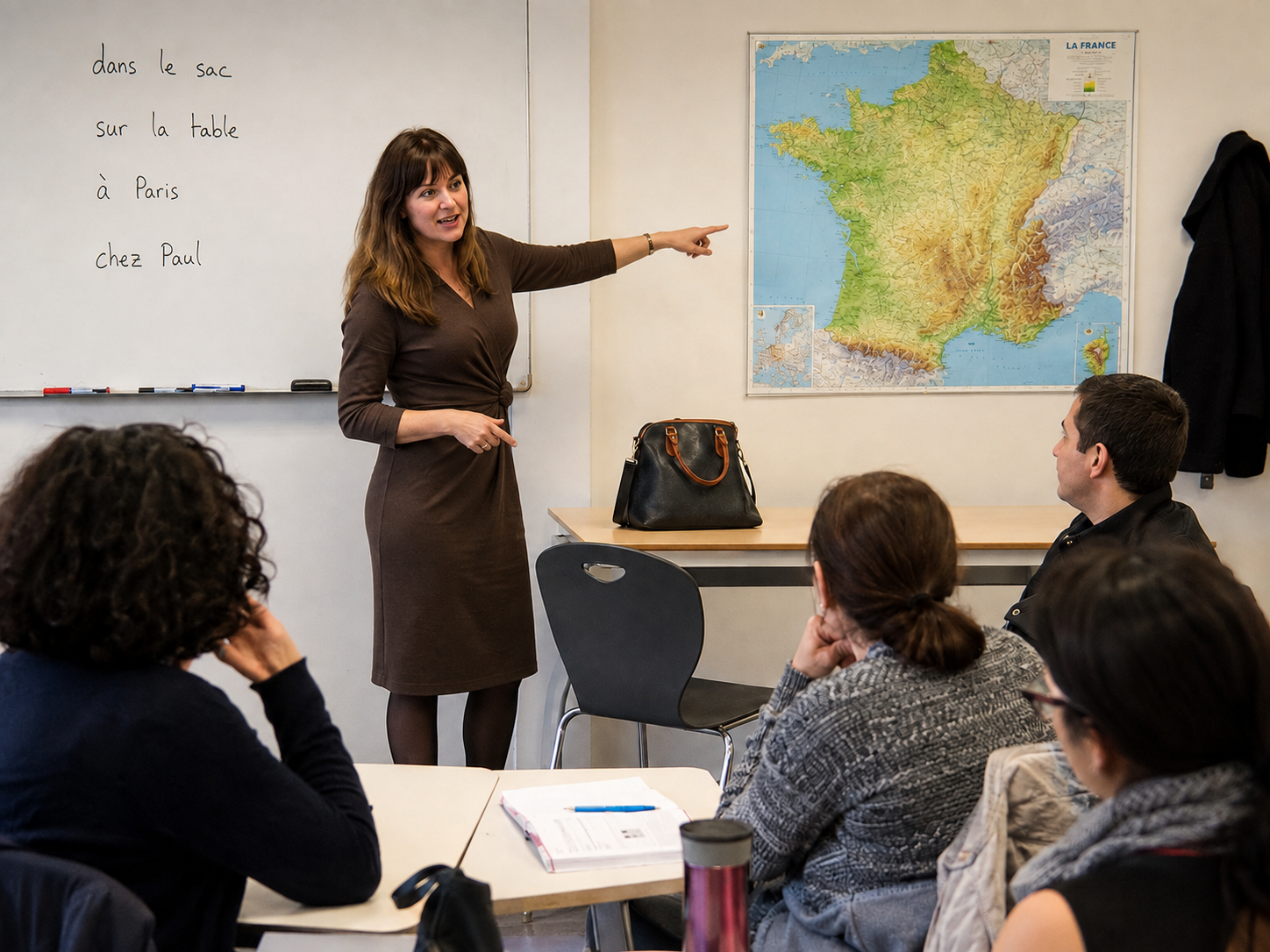
French prepositions are a perfect example of grammar that looks easy until you try to use it in a real sentence. A beginner learns that à can mean “to” or “at,” de can mean “of” or “from,” dans means “in,” and sur means “on.” Then someone wants to say “I’m going to France,” “I’m coming from Paris,” “I’m at my friend’s house,” or “I’ll be there in ten minutes,” and suddenly those simple translations are no longer enough.
The problem is not that French prepositions are impossibly irregular. It is that they do not line up neatly with English. One English preposition may have several French equivalents, while a single French preposition may cover meanings that English separates. The most useful way to learn them is therefore not to memorize à = “to,” de = “from,” and sur = “on,” but to become familiar with the combinations French speakers actually use.
For adult learners, this matters because preposition mistakes rarely make a sentence incomprehensible, but they can make otherwise good French sound noticeably unnatural. You may know exactly what you want to say and conjugate the verb correctly, yet still hesitate between à, en, dans, or chez. That hesitation gradually disappears once the patterns become familiar.
À: Going Somewhere, Being Somewhere, and Talking to Someone
À is one of the most common prepositions in French. It appears constantly with places, people, time, and certain verbs.
One of its most familiar uses is movement toward a place:
Je vais à Paris.
I’m going to Paris.
Nous allons au restaurant.
We’re going to the restaurant.
Elle va à l’université.
She’s going to the university.
À combines with the definite articles le and les:
à + le = au
à + les = aux
So we say:
Je vais au marché.
I’m going to the market.
Nous allons aux États-Unis.
We’re going to the United States.
There is no contraction with la or l’:
Je vais à la banque.
I’m going to the bank.
Je vais à l’école.
I’m going to school.
The same preposition is also used for location:
Je suis à Paris.
I’m in Paris.
Il est au bureau.
He’s at the office.
Nous sommes à la maison.
We’re at home.
This is one of the first moments when English starts interfering. English says “in Paris,” but French says à Paris. If all you mean is that you live in Paris, the natural sentence is:
J’habite à Paris.
Not normally:
J’habite dans Paris.
Dans Paris is possible, but it emphasizes the physical area within the city rather than simply naming Paris as your location.
À also appears with people after certain verbs:
Je parle à Marie.
I’m talking to Marie.
J’écris à mon professeur.
I’m writing to my teacher.
Je téléphone à mes parents.
I’m calling my parents.
Here, à identifies the person toward whom the action is directed.
Dans: Being Inside Something and Talking About Future Time
Dans is usually more physical than à. It often means that something or someone is inside a defined space.
Le livre est dans mon sac.
The book is in my bag.
Elle est dans la cuisine.
She is in the kitchen.
Les enfants jouent dans le jardin.
The children are playing in the garden.
Compare:
Je suis à la banque.
I’m at the bank.
Je suis dans la banque.
I’m inside the bank.
The first tells us your general location. The second emphasizes that you are physically inside the building.
The same distinction appears with a café:
Je suis au café.
I’m at the café.
Je suis dans le café.
I’m inside the café.
This difference becomes easier to feel once you stop translating every English “in” as dans.
Dans also has a very common time meaning:
Je pars dans dix minutes.
I’m leaving in ten minutes.
Nous revenons dans une semaine.
We’ll be back in a week.
Le cours commence dans une heure.
The class starts in an hour.
Here, dans means that something will happen after a certain amount of time has passed.
This is different from pendant:
Je travaille pendant deux heures.
I’m working for two hours.
Compare:
Je pars dans deux heures.
I’m leaving in two hours.
Je travaille pendant deux heures.
I’m working for two hours.
The first tells us when something will happen. The second tells us how long it lasts.
De: From, Of, About, and Part of Many Verb Expressions
De is every bit as common as à and appears in a wide range of structures.
One of its basic meanings is origin:
Je viens de Paris.
I come from Paris.
Elle revient du travail.
She is coming back from work.
Nous revenons des États-Unis.
We’re coming back from the United States.
Like à, de contracts with certain definite articles:
de + le = du
de + les = des
So we say:
Je viens du marché.
I’m coming from the market.
Nous revenons des Alpes.
We’re coming back from the Alps.
There is no contraction with la or l’:
Je viens de la bibliothèque.
I’m coming from the library.
Je reviens de l’école.
I’m coming back from school.
De also frequently expresses possession or relationship:
le livre de Marie
Marie’s book
la voiture de mon frère
my brother’s car
le centre de Paris
the center of Paris
English often uses an apostrophe-s where French prefers a structure with de, so the word order takes a little getting used to.
De becomes especially important because many French verbs naturally require it:
parler de
to talk about
avoir besoin de
to need
essayer de
to try to
décider de
to decide to
arrêter de
to stop doing
Nous parlons de notre voyage.
We’re talking about our trip.
J’ai besoin de dormir.
I need to sleep.
Elle essaie de comprendre.
She is trying to understand.
Ils ont décidé de partir.
They decided to leave.
These combinations are easiest to learn as phrases. Instead of remembering décider and later trying to work out which preposition follows it, it is more useful to remember décider de faire quelque chose.
The difference between à and de can even change the meaning of the same verb. Parler is a good example:
Je parle à Marie.
I’m talking to Marie.
Je parle de Marie.
I’m talking about Marie.
The verb has not changed. The preposition tells us Marie’s role in the sentence.
Sur: More Than Simply “On”
Sur is usually introduced as “on,” and in physical descriptions that works well:
Le téléphone est sur la table.
The phone is on the table.
Il y a un tableau sur le mur.
There is a picture on the wall.
Elle pose son sac sur la chaise.
She puts her bag on the chair.
Sur can also mean “about” when we are talking about the subject of a book, article, film, lecture, or similar item:
un livre sur la Révolution française
a book about the French Revolution
un documentaire sur Paris
a documentary about Paris
un article sur la cuisine française
an article about French cuisine
This does not mean sur and de are interchangeable whenever English uses “about.” French says parler de quelque chose because parler takes de in that construction, while a book or article on a particular subject commonly uses sur.
That is why apprendre le français par groupes de mots—learning French in groups of words rather than isolated items—becomes so useful at the intermediate level.
En: Countries, Transportation, and Time
En is one of the prepositions learners encounter almost immediately when talking about countries.
With feminine countries and countries beginning with a vowel, French generally uses en:
Je vais en France.
I’m going to France.
Elle habite en Italie.
She lives in Italy.
Nous voyageons en Espagne.
We’re traveling in Spain.
With masculine countries, French generally uses au:
Je vais au Canada.
I’m going to Canada.
Il habite au Japon.
He lives in Japan.
And with plural countries:
Je vais aux États-Unis.
I’m going to the United States.
Cities follow a different pattern:
à Paris
en France
à Rome
en Italie
à Tokyo
au Japon
This is one reason learning the gender of countries is more practical than it may initially seem.
En also appears with transportation:
en voiture
by car
en train
by train
en avion
by plane
en bus
by bus
Nous voyageons en train.
We’re traveling by train.
Je vais au travail en voiture.
I go to work by car.
French traditionally uses à with forms of transportation that you ride or use without being enclosed in the same way:
à pied
on foot
à vélo
by bike
à moto
by motorcycle
Je vais au travail à vélo.
I go to work by bike.
En has another important use with time. It can describe how long an action takes to complete:
J’ai fait le travail en deux heures.
I did the work in two hours.
J’ai lu le livre en trois jours.
I read the book in three days.
Compare that with dans:
Je vais faire le travail dans deux heures.
I’m going to do the work in two hours.
Je commencerai le livre dans trois jours.
I’ll start the book in three days.
En describes the amount of time required to complete something. Dans tells you how much time will pass before something happens.
Chez: One of the Most Useful Prepositions With No Exact English Match
Chez is difficult to translate with one English word because English expresses the same idea in several ways.
French uses chez when referring to someone’s home or place:
Je suis chez Marie.
I’m at Marie’s house.
Nous allons chez mes parents.
We’re going to my parents’ place.
It is also used with certain professionals and businesses associated with a person:
Je vais chez le médecin.
I’m going to the doctor.
Elle est chez le coiffeur.
She’s at the hairdresser’s.
The important idea is the person or professional rather than the physical building.
When you leave someone’s place, French uses de chez:
Je viens de chez Paul.
I’m coming from Paul’s place.
Je rentre de chez le médecin.
I’m coming back from the doctor’s.
Chez can even be used more broadly:
Chez les Français, le repas peut être un moment social important.
Depending on context, this means something like “among French people” or “in French culture.”
Once you become comfortable with chez, it begins to feel much more natural than trying to construct everything literally from English.
Pour and Par: Similar Translations, Different Jobs
Pour is often translated as “for”:
Ce cadeau est pour toi.
This gift is for you.
Je travaille pour une entreprise française.
I work for a French company.
Nous partons pour Paris demain.
We’re leaving for Paris tomorrow.
Pour can also express an intended period of time:
Je pars pour trois jours.
I’m leaving for three days.
Par often means “by” in passive constructions:
un livre écrit par Victor Hugo
a book written by Victor Hugo
It also appears with frequency:
deux fois par semaine
twice a week
and with routes or movement through a place:
Nous passons par Lyon.
We’re going through Lyon.
English “for” and “by” each cover many different ideas, so simply looking up a translation will not always tell you whether pour or par belongs in a sentence.
Cities and Countries Become Easier When You Learn the Patterns Together
Place prepositions are much easier to remember when you learn where someone is going and where they are coming from as a pair.
For cities:
Je vais à Paris.
I’m going to Paris.
Je viens de Paris.
I’m coming from Paris.
For feminine countries:
Je vais en France.
I’m going to France.
Je viens de France.
I’m coming from France.
For masculine countries:
Je vais au Canada.
I’m going to Canada.
Je viens du Canada.
I’m coming from Canada.
For plural countries:
Je vais aux États-Unis.
I’m going to the United States.
Je viens des États-Unis.
I’m coming from the United States.
The same approach works with everyday places:
Je vais au restaurant.
Je reviens du restaurant.
Je vais à la bibliothèque.
Je reviens de la bibliothèque.
Je vais chez Paul.
Je reviens de chez Paul.
When these combinations are practiced together, the preposition starts to feel like part of the expression instead of something you have to choose from scratch every time.
Prepositions Make More Sense Inside Real Sentences
The frustrating thing about French prepositions is that you can understand a rule perfectly and still hesitate when speaking. You may know that cities take à but momentarily hear the English phrase “in Paris” in your head. You may know that penser à is a common structure and still reach for de because English is influencing the sentence.
That is why short, realistic combinations are so useful:
aller à Paris
venir de Paris
avoir besoin de
penser à
parler de
parler à quelqu’un
être chez quelqu’un
partir dans une heure
You can also practice them by describing an ordinary part of your day:
Je suis à la maison.
I’m at home.
Mon téléphone est sur la table.
My phone is on the table.
Mes clés sont dans mon sac.
My keys are in my bag.
Je vais au travail en bus.
I’m going to work by bus.
Je parle à ma collègue.
I’m talking to my colleague.
Nous parlons de notre projet.
We’re talking about our project.
Je rentre chez moi à six heures.
I go home at six.
Now the prepositions are no longer a list of tiny grammar words. They describe where things are, where people are going, who they are speaking to, and how actions relate to one another.
For adults who want more structured practice using grammar in actual conversation, Polyglottist Language Academy offers French classes for adults. Prepositions tend to become much easier when learners repeatedly hear and use them in meaningful sentences rather than trying to choose them through translation alone.
Even advanced French learners occasionally hesitate over a preposition, and there is no need to expect every choice to become perfectly predictable. What changes with experience is that expressions such as à Paris, en France, chez Marie, sur la table, dans le sac, parler à quelqu’un, and parler de quelque chose begin to sound natural without requiring a grammatical calculation each time.
That is when French prepositions stop feeling like a collection of exceptions and start feeling like part of the language.