
French Modal Verbs: "Pouvoir," "Vouloir," "Devoir" and Their Uses
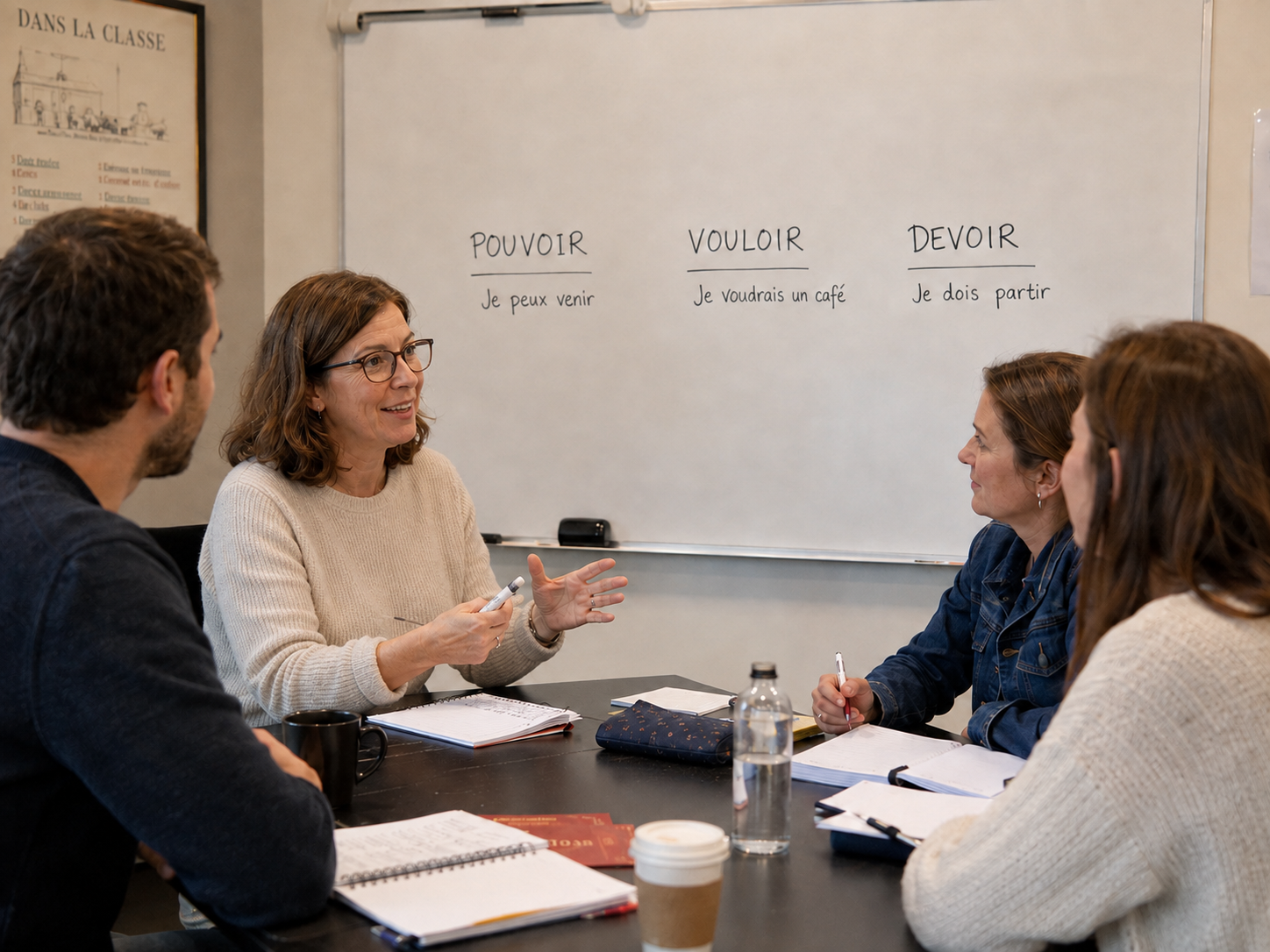
One of the moments when French begins to feel genuinely useful is when you can move beyond simple statements and start expressing what you can do, what you want to do, and what you have to do. Suddenly you can explain that you can meet someone tomorrow, that you would like a coffee, that you have to leave early, or that a friend should speak to a doctor. Three very common verbs make much of this possible: pouvoir, vouloir, and devoir.
They are often introduced together because they frequently follow the same basic pattern: the first verb is conjugated, and the action that follows remains in the infinitive. Je peux venir means “I can come,” je veux venir means “I want to come,” and je dois venir means “I have to come.” The grammar is compact, but the meanings are not always as straightforward as their English translations suggest.
Adult learners often become comfortable with the conjugations before they become comfortable choosing the right verb in conversation. Pouvoir can express ability, possibility, permission, or a polite request. Vouloir can sound direct or perfectly natural depending on the context, while its conditional form, je voudrais, is one of the most useful polite expressions in French. Devoir can express obligation, advice, or even probability. Understanding those differences is what turns these verbs from vocabulary items into tools you can actually use.
Pouvoir: Ability, Possibility, and Permission
Pouvoir is usually translated as “can” or “to be able to,” and that basic meaning is easy to recognize.
Je peux venir demain.
I can come tomorrow.
Elle peut parler français.
She can speak French.
Nous pouvons commencer maintenant.
We can start now.
When pouvoir is followed by another verb, only pouvoir is conjugated. The second verb remains in the infinitive:
Je peux conduire.
I can drive.
Tu peux attendre.
You can wait.
Ils peuvent entrer.
They can come in.
One of the most common beginner errors is to conjugate the second verb as well. A learner may write Je peux parlebecause “can” and “speak” both feel active in English. French does not work that way. The correct form is je peux parler.
Pouvoir is also the ordinary verb for asking whether something is allowed.
Je peux ouvrir la fenêtre ?
Can I open the window?
On peut s'asseoir ici ?
Can we sit here?
Vous pouvez entrer.
You can come in / You may come in.
Learners sometimes encounter Puis-je entrer ? very early because it appears in traditional textbooks. It is correct, but it belongs to a more formal register. In ordinary conversation, Je peux entrer ? or Est-ce que je peux entrer ? is far more common.
That distinction matters because French learners sometimes assume that the more elaborate grammatical form must be the more natural one. It often is not. A sentence can be perfectly correct and still sound unusually formal for the situation.
Pouvoir becomes especially useful when you want to make a request politely. Compare:
Vous pouvez m'aider ?
Can you help me?
with:
Vous pourriez m'aider ?
Could you help me?
The second version uses the conditional, pourriez, and sounds softer. The same pattern works in many everyday situations:
Est-ce que vous pourriez répéter ?
Could you repeat that?
Vous pourriez m'apporter de l'eau, s'il vous plaît ?
Could you bring me some water, please?
Once learners begin using pourriez naturally, they no longer need to memorize a separate polite phrase for every request. They can build their own.
There is one other distinction that often causes confusion. English uses “can” both for knowing how to do something and for being able to do it under particular circumstances. French often separates those meanings.
Je sais nager.
I know how to swim.
Je peux nager aujourd'hui.
I can swim today.
Savoir is about knowing how. Pouvoir is about ability or possibility in the situation. Someone who learned to swim years ago says je sais nager. Someone recovering from an injury who has finally been given permission to swim again might say je peux nager maintenant.
Vouloir: Wanting Something and Asking for It
Vouloir means “to want,” but this is one of those verbs where translation alone is not enough.
Je veux un café.
I want a coffee.
The sentence is grammatically correct, and in some situations it is completely natural. The problem is that English-speaking learners often use je veux in situations where French would normally soften the request.
At a café, hotel, shop, or restaurant, you will often hear:
Je voudrais un café, s'il vous plaît.
I would like a coffee, please.
Je voudrais réserver une chambre.
I would like to reserve a room.
Je voudrais parler à Madame Dupont.
I would like to speak with Madame Dupont.
Je voudrais is the conditional form of vouloir, but in practical conversation it functions much like “I would like.”
This does not mean je veux is rude and should be avoided. It depends on what you are doing with the sentence. If someone asks:
Qu'est-ce que tu veux faire ce soir ?
What do you want to do tonight?
you can answer naturally:
Je veux rester à la maison.
I want to stay home.
You are stating your own preference, not making a request of someone else. There is no need to soften it.
The difference becomes clearer when you compare a child and an adult in a service situation. A child might say:
Je veux une glace !
I want ice cream!
At an ice cream shop, an adult would usually say:
Je voudrais une glace, s'il vous plaît.
I would like an ice cream, please.
The desire is the same, but the social relationship is different.
Vouloir is also used constantly for invitations and offers.
Tu veux venir avec nous ?
Do you want to come with us?
Tu veux du café ?
Do you want some coffee?
Vous voulez boire quelque chose ?
Would you like something to drink?
The last example is especially useful because French often uses vouloir where English naturally chooses “would you like.” A learner who translates word for word may think Vous voulez du café ? sounds too direct, but in a normal friendly context it can be completely natural.
This is one reason listening matters. The verb has to be understood in context, not assigned one fixed English equivalent.
Devoir: From “Have To” to “Should” and “Must Be”
Devoir is usually introduced as “must” or “to have to.”
Je dois travailler demain.
I have to work tomorrow.
Nous devons partir à huit heures.
We have to leave at eight.
Vous devez attendre ici.
You must wait here.
That basic meaning is important, but devoir becomes much more interesting once learners encounter it in real conversation because it does more than express obligation.
In the present tense, it often indicates necessity:
Je dois finir ce travail aujourd'hui.
I have to finish this work today.
On doit réserver à l'avance.
We have to book in advance.
Tu dois prendre tes médicaments.
You have to take your medication.
The force of devoir depends heavily on context. Tu dois voir ce film ! literally looks like “You have to see this movie,” but it is usually just an enthusiastic recommendation. No one is imposing a real obligation.
The conditional changes the tone more clearly:
Tu dois dormir davantage.
You have to sleep more.
Tu devrais dormir davantage.
You should sleep more.
Vous devriez parler à votre professeur.
You should speak to your teacher.
On devrait partir plus tôt.
We should leave earlier.
This difference between dois and devrais is extremely useful. Learners often know how to give direct instructions before they know how to give advice, which can make them sound firmer than intended. Tu dois apprendre plus de vocabulaire sounds like an instruction. Tu devrais apprendre un peu plus de vocabulaire sounds much more like a suggestion.
The same conditional pattern appears with the other modal verbs too. Je voudrais, vous pourriez, and tu devrais are all high-frequency forms because they allow speakers to soften what they say.
Devoir also has another meaning that learners sometimes miss completely: probability.
Il doit être chez lui.
He must be at home.
Ça doit être difficile.
That must be difficult.
Elle doit avoir environ quarante ans.
She must be around forty.
Ils doivent déjà être arrivés.
They must have arrived already.
In these sentences, no one is under an obligation. The speaker is making a deduction based on what seems likely.
Context usually makes the distinction clear. Il doit partir à huit heures probably means “He has to leave at eight.” Il doit être fatigué almost certainly means “He must be tired.”
Once learners get used to this, devoir starts to feel less like a single vocabulary item and more like a verb with several common conversational functions.
The Same Action Changes With the Modal Verb
One of the easiest ways to understand pouvoir, vouloir, and devoir is to keep the main action the same and change only the modal verb.
Take partir, “to leave.”
Je peux partir.
I can leave.
Je veux partir.
I want to leave.
Je dois partir.
I have to leave.
The action is identical, but the speaker's relationship to it changes. With pouvoir, leaving is possible. With vouloir, it is desired. With devoir, it is necessary.
The conditional gives you another set of useful distinctions:
Je pourrais partir.
I could leave.
Je voudrais partir.
I would like to leave.
Je devrais partir.
I should leave.
This comparison is useful because it shows how much meaning comes from the modal verb itself.
You can do the same with venir, parler, attendre, manger, travailler, or almost any other familiar infinitive.
Je peux venir demain.
I can come tomorrow.
Je veux venir demain.
I want to come tomorrow.
Je dois venir demain.
I have to come tomorrow.
Then:
Je pourrais venir demain.
I could come tomorrow.
Je voudrais venir demain.
I would like to come tomorrow.
Je devrais venir demain.
I should come tomorrow.
With only one infinitive, you are already practicing possibility, desire, obligation, politeness, and advice.
Questions Sound Different Depending on the Situation
French gives you several ways to ask questions with these verbs, and all of them can be correct.
In casual conversation, intonation is extremely common:
Tu peux venir demain ?
Can you come tomorrow?
Tu veux manger ?
Do you want to eat?
Tu dois travailler samedi ?
Do you have to work Saturday?
Est-ce que is also natural:
Est-ce que vous pouvez m'aider ?
Can you help me?
Est-ce que tu veux venir ?
Do you want to come?
Est-ce qu'on doit réserver ?
Do we have to reserve?
Formal inversion is useful in more formal contexts:
Pouvez-vous m'aider ?
Can you help me?
Voulez-vous entrer ?
Would you like to come in?
Devez-vous partir maintenant ?
Do you have to leave now?
Learners sometimes spend too much energy trying to decide which one is “the French way.” French does not have one question structure that must be used in every context. A conversation with a friend, a conversation with a hotel receptionist, and a written formal request do not need to sound identical.
Being able to move between these levels of formality is part of sounding natural.
Pronunciation Matters More Than the Conjugation Table Suggests
The written forms of pouvoir, vouloir, and devoir can look intimidating, especially because several forms end differently even when the pronunciation is similar.
With pouvoir:
Je peux
Tu peux
Il peut
The final x and t are not pronounced.
Vouloir follows a similar pattern:
Je veux
Tu veux
Il veut
And devoir:
Je dois
Tu dois
Il doit
The plural forms sound more distinct:
Nous pouvons
Vous pouvez
Ils peuvent
Nous voulons
Vous voulez
Ils veulent
Nous devons
Vous devez
Ils doivent
Learners who study mainly from written materials sometimes try to pronounce every visible consonant, especially in forms such as peux, veut, or doit. It is much better to learn the sound of the form at the same time as the spelling.
The same is true of recognition. Being able to write je veux correctly is useful, but in conversation you also need to recognize it immediately when someone says it quickly inside a longer sentence.
How These Verbs Become Automatic
The most effective practice is usually simple: take verbs you already know and combine them repeatedly with pouvoir, vouloir, and devoir.
Instead of learning more vocabulary at the same time, work with familiar verbs and change the intention of the sentence.
Je peux travailler demain.
I can work tomorrow.
Je veux travailler demain.
I want to work tomorrow.
Je dois travailler demain.
I have to work tomorrow.
Then change the tense or mood:
Je pourrais travailler demain.
I could work tomorrow.
Je voudrais travailler demain.
I would like to work tomorrow.
Je devrais travailler demain.
I should work tomorrow.
You can do the same with questions:
Tu peux venir ?
Can you come?
Tu veux venir ?
Do you want to come?
Tu dois venir ?
Do you have to come?
This kind of repetition is useful because it trains meaning, not just form. In actual conversation, you do not want to stop and think, “I need the first-person conditional of devoir.” You want je devrais to appear because “I should” is what you are trying to say.
That transition from understanding a rule to using it without hesitation takes practice. It is also why these verbs tend to come up again and again in structured French classes. They are involved in making plans, ordering food, asking favors, explaining obligations, giving advice, and discussing possibilities, so there are many opportunities to practice them in realistic conversation.
For adults who would like more structured practice with French grammar in actual speech, Polyglottist Language Academy offers French classes for adults.
These three verbs do a remarkable amount of work in everyday French. Once you are comfortable with them, you can move beyond simply reporting what happens and start expressing possibility, preference, necessity, politeness, advice, and probability. That is a relatively small piece of grammar, but it changes the range of things you are able to say.